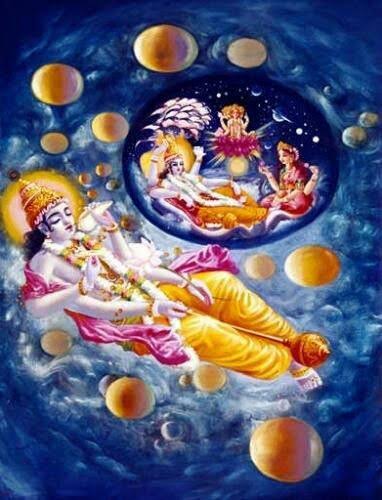
"The Subterranean Heavenly Planets"
Srimad Bhagavatam Canto 5 Chapter 24 Text 1 to Text 31.
By His Divine Grace A.C Bhaktivedanta Swami Prabhupada.
This chapter describes the planet Rāhu, which is 10,000 yojanas (80,000 miles) below the sun, and it also describes Atala and the other lower planetary systems.
Rāhu is situated below the sun and moon. It is between these two planets and the earth.
When Rāhu conceals the sun and moon, eclipses occur, either total or partial, depending on whether Rāhu moves in a straight or curving way.
Below Rāhu by another 1,000,000 yojanas (8 million miles) are the planets of the Siddhas, Cāraṇas and Vidyādharas, and below these are planets such as Yakṣaloka and Rakṣaloka.
Below these planets is the earth, and 70,000 yojanas (280,000 miles) below the earth are the lower planetary systems — Atala, Vitala, Sutala, Talātala, Mahātala, Rasātala and Pātāla.
Demons and Rakṣasas live in these lower planetary systems with their wives and children, always engaged in sense gratification and not fearing their next births.
The sunshine does not reach these planets, but they are illuminated by jewels fixed upon the hoods of snakes. Because of these shining gems there is practically no darkness.
Those living in these planets do not become old or diseased, and they are not afraid of death from any cause but the time factor, the Supreme Personality of Godhead.
In the planet Atala, the yawning of a demon has produced three kinds of women, called svairiṇī (independent), kāmiṇī (lusty) and puḿścalī (very easily subdued by men).
Below Atala is the planet Vitala, wherein Lord Śiva and his wife Gaurī reside.
Because of their presence, a kind of gold is produced called hāṭaka.
Below Vitala is the planet Sutala, the abode of Bali Mahārāja, the most fortunate king.
Bali Mahārāja was favored by the Supreme Personality of Godhead, Vāmanadeva, because of his intense devotional service.
The Lord went to the sacrificial arena of Bali Mahārāja and begged him for three paces of land, and on this plea the Lord took from him all his possessions.
When Bali Mahārāja agreed to all this, the Lord was very pleased, and therefore the Lord serves as his doorkeeper.
The description of Bali Mahārāja appears in the Eighth Canto of Śrīmad-Bhāgavatam.
When the Supreme Personality of Godhead offers a devotee material happiness, this is not His real favor.
The demigods, who are very puffed up by their material opulence, pray to the Lord only for material happiness, not knowing anything better.
Devotees like Prahlāda Mahārāja, however, do not want material happiness.
Not to speak of material happiness, they do not want even liberation from material bondage, although one can achieve this liberation simply by chanting the holy name of the Lord, even with improper pronunciation.
Below Sutala is the planet Talātala, the abode of the demon Maya. This demon is always materially happy because he is favored by Lord Śiva, but he cannot achieve spiritual happiness at any time.
Below Talātala is the planet Mahātala, where there are many snakes with hundreds and thousands of hoods.
Below Mahātala is Rasātala, and below that is Pātāla, where the serpent Vasukī lives with his associates.
SB 5.24 Text 1
Śrī Śukadeva Gosvāmī said: My dear King, some historians, the speakers of the Purāṇas, say that 10,000 yojanas [80,000 miles] below the sun is the planet known as Rāhu, which moves like one of the stars.
The presiding deity of that planet, who is the son of Siṁhikā, is the most abominable of all asuras, but although he is completely unfit to assume the position of a demigod or planetary deity, he has achieved that position by the grace of the Supreme Personality of Godhead. Later I shall speak further about him.
SB 5.24 Text 2
The sun globe, which is a source of heat, extends for 10,000 yojanas [80,000 miles]. The moon extends for 20,000 yojanas [160,000 miles], and Rāhu extends for 30,000 yojanas [240,000 miles].
Formerly, when nectar was being distributed, Rāhu tried to create dissension between the sun and moon by interposing himself between them.
Rāhu is inimical toward both the sun and the moon, and therefore he always tries to cover the sunshine and moonshine on the dark-moon day and full-moon night.
Purport:
As stated herein, the sun extends for 10,000 yojanas, and the moon extends for twice that, or 20,000 yojanas. The word dvādaśa should be understood to mean twice as much as ten, or twenty.
In the opinion of Vijayadhvaja, the extent of Rāhu should be twice that of the moon, or 40,000 yojanas.
However to reconcile this apparent contradiction to the text of the Bhāgavatam, Vijayadhvaja cites the following quotation concerning Rāhu; rāhu-soma-ravīṇāṁ tu maṇḍalā dvi-guṇoktitām.
This means that Rāhu is twice as large as the moon, which is twice as large as the sun. This is the conclusion of the commentator Vijayadhvaja.
SB 5.24. Text 3
After hearing from the sun and moon demigods about Rāhu’s attack, the Supreme Personality of Godhead, Viṣṇu, engages His disc, known as the Sudarśana cakra, to protect them.
The Sudarśana cakra is the Lord’s most beloved devotee and is favored by the Lord.
The intense heat of its effulgence, meant for killing non-Vaiṣṇavas, is unbearable to Rāhu, and he therefore flees in fear of it.
During the time Rāhu disturbs the sun or moon, there occurs what people commonly know as an eclipse.
Purport:
The Supreme Personality of Godhead, Viṣṇu, is always the protector of His devotees, who are also known as demigods.
The controlling demigods are most obedient to Lord Viṣṇu, although they also want material sense enjoyment, and that is why they are called demigods, or almost godly.
Although Rāhu attempts to attack both the sun and the moon, they are protected by Lord Viṣṇu.
Being very afraid of Lord Viṣṇu’s cakra, Rāhu cannot stay in front of the sun or moon for more than a muhūrta (forty-eight minutes).
The phenomenon that occurs when Rāhu blocks the light of the sun or moon is called an eclipse.
The attempt of the scientists of this earth to go to the moon is as demoniac as Rāhu’s attack.
Of course. their attempts will be failures because no one can enter the moon or sun so easily. Like the attack of Rāhu, such attempts will certainly be failures.
SB 5.24. Text 4
Below Rāhu by 10,000 yojanas [80,000 miles] are the planets known as Siddhaloka, Cāraṇaloka and Vidyādhara-loka.
Purport:
It is said that the residents of Siddhaloka, being naturally endowed with the powers of yogīs, can go from one planet to another by their natural mystic powers without using airplanes or similar machines.
SB 5.24. Text 5
Beneath Vidyādhara-loka, Cāraṇaloka and Siddhaloka, in the sky called antarikṣa, are the places of enjoyment for the Yakṣas, Rākṣasas, Piśācas, ghosts and so on. Antarikṣa extends as far as the wind blows and the clouds float in the sky. Above this there is no more air.
SB 5.24. Text 6
Below the abodes of the Yakṣas and Rākṣasas by a distance of 100 yojanas [800 miles] is the planet earth. Its upper limits extend as high as swans, hawks, eagles and similar large birds can fly.
SB 5.24. Text 7
My dear King, beneath this earth are seven other planets, known as Atala, Vitala, Sutala, Talātala, Mahātala, Rasātala and Pātāla.
I have already explained the situation of the planetary systems of earth. The width and length of the seven lower planetary systems are calculated to be exactly the same as those of earth.
SB 5.24. Text 8
In these seven planetary systems, which are also known as the subterranean heavens [bila-svarga], there are very beautiful houses, gardens and places of sense enjoyment, which are even more opulent than those in the higher planets because the demons have a very high standard of sensual pleasure, wealth and influence.
Most of the residents of these planets, who are known as Daityas, Dānavas and Nāgas, live as householders. Their wives, children, friends and society are all fully engaged in illusory material happiness.
The sense enjoyment of the demigods is sometimes disturbed, but the residents of these planets enjoy life without disturbances. Thus they are understood to be very attached to illusory happiness.
Purport:
According to the statements of Prahlāda Mahārāja, material enjoyment is māyā-sukha, illusory enjoyment. A Vaiṣṇava is full of anxieties for the deliverance of all living entities from such false enjoyment.
Prahlāda Mahārāja says, māyā-sukhāya bharam udvahato vimūḍhān: these fools (vimūḍhas) are engaged in material happiness, which is surely temporary.
Whether in the heavenly planets, the lower planets or the earthly planets, people are engrossed in temporary, material happiness, forgetting that in due course of time they have to change their bodies according to the material laws and suffer the repetition of birth, death, old age and disease.
Not caring what will happen in the next birth, gross materialists are simply busy enjoying during the present short span of life.
A Vaiṣṇava is always anxious to give all such bewildered materialists the real happiness of spiritual bliss.
SB 5.24. Text 9
My dear King, in the imitation heavens known as bila-svarga there is a great demon named Maya Dānava, who is an expert artist and architect. He has constructed many brilliantly decorated cities.
There are many wonderful houses, walls, gates, assembly houses, temples, yards and temple compounds, as well as many hotels serving as residential quarters for foreigners.
The houses for the leaders of these planets are constructed with the most valuable jewels, and they are always crowded with living entities known as Nāgas and Asuras, as well as many pigeons, parrots and similar birds. All in all, these imitation heavenly cities are most beautifully situated and attractively decorated.
SB 5.24. Text 10
The parks and gardens in the artificial heavens surpass in beauty those of the upper heavenly planets.
The trees in those gardens, embraced by creepers, bend with a heavy burden of twigs with fruits and flowers, and therefore they appear extraordinarily beautiful.
That beauty could attract anyone and make his mind fully blossom in the pleasure of sense gratification.
There are many lakes and reservoirs with clear, transparent water, agitated by jumping fish and decorated with many flowers such as lilies, kuvalayas, kahlāras and blue and red lotuses.
Pairs of cakravākas and many other water birds nest in the lakes and always enjoy in a happy mood, making sweet, pleasing vibrations that are very satisfying and conducive to enjoyment of the senses.
SB 5.24. Text 11
Since there is no sunshine in those subterranean planets, time is not divided into days and nights, and consequently fear produced by time does not exist.
SB 5.24. Text 12
Many great serpents reside there with gems on their hoods, and the effulgence of these gems dissipates the darkness in all directions.
SB 5.24. Text 13
Since the residents of these planets drink and bathe in juices and elixirs made from wonderful herbs, they are freed from all anxieties and physical diseases.
They have no experience of grey hair, wrinkles or invalidity, their bodily lusters do not fade, their perspiration does not cause a bad smell, and they are not troubled by fatigue or by lack of energy or enthusiasm due to old age.
SB 5.24. Text 14
They live very auspiciously and do not fear death from anything but death’s established time, which is the effulgence of the Sudarśana cakra of the Supreme Personality of Godhead.
Purport:
This is the defect of material existence. Everything in the subterranean heavens is very nicely arranged.
There are well situated residential quarters, there is a pleasing atmosphere, and there are no bodily inconveniences or mental anxieties, but nevertheless those who live there have to take another birth according to karma.
Persons whose minds are dull cannot understand this defect of a materialistic civilization aiming at material comforts.
One may make his living conditions very pleasing for the senses, but despite all favorable conditions, one must in due course of time meet death.
The members of a demoniac civilization endeavor to make their living conditions very comfortable, but they cannot check death. The influence of the Sudarśana cakra will not allow their so-called material happiness to endure.
SB 5.24. Text 15
When the Sudarśana disc enters those provinces, the pregnant wives of the demons all have miscarriages due to fear of its effulgence.
SB 5.24. Text 16
My dear King, now I shall describe to you the lower planetary systems, one by one, beginning from Atala. In Atala there is a demon, the son of Maya Dānava named Bala, who created ninety-six kinds of mystic power.
Some so-called yogīs and svāmīs take advantage of this mystic power to cheat people even today. Simply by yawning, the demon Bala created three kinds of women, known as svairiṇī, kāmiṇī and puḿścalī.
The svairiṇīs like to marry men from their own group, the kāmiṇīs marry men from any group, and the puḿścalīs change husbands one after another.
If a man enters the planet of Atala, these women immediately capture him and induce him to drink an intoxicating beverage made with a drug known as hāṭaka [cannabis indica].
This intoxicant endows the man with great sexual prowess, of which the women take advantage for enjoyment.
A woman will enchant him with attractive glances, intimate words, smiles of love and then embraces. In this way she induces him to enjoy sex with her to her full satisfaction.
Because of his increased sexual power, the man thinks himself stronger than ten thousand elephants and considers himself most perfect. Indeed, illusioned and intoxicated by false pride, he thinks himself God, ignoring impending death.
ŚB 5.24. Text 17
The next planet below Atala is Vitala, wherein Lord Śiva, who is known as the master of gold mines, lives with his personal associates, the ghosts and similar living entities.
Lord Śiva, as the progenitor, engages in sex with Bhavānī, the progenitress, to produce living entities, and from the mixture of their vital fluid the river named Hāṭakī is generated.
When fire, being made to blaze by the wind, drinks of this river and then sizzles and spits it out, it produces gold called Hāṭaka.
The demons who live on that planet with their wives decorate themselves with various ornaments made from that gold, and thus they live there very happily.
Purport:
It appears that when Bhava and Bhavānī, Lord Śiva and his wife, unite sexually, the emulsification of their secretions creates a chemical which when heated by fire can produce gold.
It is said that the alchemists of the medieval age tried to prepare gold from base metal, and Śrīla Sanātana Gosvāmī also states that when bell metal is treated with mercury, it can produce gold.
Śrīla Sanātana Gosvāmī mentions this in regard to the initiation of low-class men to turn them into brāhmaṇas. Sanātana Gosvāmī said:
yathā kāñcanatāḿ yātikāḿsyaḿ rasa-vidhānataḥtathā dīkṣā-vidhānenadvijatvaḿ jāyate nṛṇām
"As one can transform kaḿsa, or bell metal, into gold by treating it with mercury, one can also turn a lowborn man into a brāhmaṇa by initiating him properly into Vaiṣṇava activities."
The International Society for Krishna Consciousness is trying to turn mlecchas and yavanas into real brāhmaṇas by properly initiating them and stopping them from engaging in meat-eating, intoxication, illicit sex and gambling.
One who stops these four principles of sinful activity and chants the Hare Kṛṣṇa mahā-mantra can certainly become a pure brāhmaṇa through the process of bona fide initiation, as suggested by Śrīla Sanātana Gosvāmī.
Apart from this, if one takes a hint from this verse and learns how to mix mercury with bell metal by properly heating and melting them, one can get gold very cheaply.
The alchemists of the medieval age tried to manufacture gold, but they were unsuccessful, perhaps because they did not follow the right instructions.
ŚB 5.24. Text 18
Below the planet Vitala is another planet, known as Sutala, where the great son of Mahārāja Virocana, Bali Mahārāja, who is celebrated as the most pious king, resides even now.
For the welfare of Indra, the King of heaven, Lord Viṣṇu appeared in the form of a dwarf brahmacārī as the son of Aditi and tricked Bali Mahārāja by begging for only three paces of land but taking all the three worlds.
Being very pleased with Bali Mahārāja for giving all his possessions, the Lord returned his kingdom and made him richer than the opulent King Indra.
Even now, Bali Mahārāja engages in devotional service by worshiping the Supreme Personality of Godhead in the planet of Sutala.
Purport:
The Supreme Personality of Godhead is described as Uttamaśloka, "He who is worshiped by the best of selected Sanskrit verses," and His devotees such as Bali Mahārāja are also worshiped by puṇya-śloka, verses that increase one's piety.
Bali Mahārāja offered everything to the Lord — his wealth, his kingdom and even his own body (sarvātma-nivedane baliḥ).
The Lord appeared before Bali Mahārāja as a brāhmaṇa beggar, and Bali Mahārāja gave Him everything he had. However, Bali Mahārāja did not become poor; by donating all his possessions to the Supreme Personality of Godhead, he became a successful devotee and got everything back again with the blessings of the Lord.
Similarly, those who give contributions to expand the activities of the Kṛṣṇa consciousness movement and to accomplish its objectives will never be losers; they will get their wealth back with the blessings of Lord Kṛṣṇa.
On the other side, those who collect contributions on behalf of the International Society for Krishna Consciousness should be very careful not to use even a farthing of the collection for any purpose other than the transcendental loving service of the Lord.
ŚB 5.24. Text 19
My dear King, Bali Mahārāja donated all his possessions to the Supreme Personality of Godhead, Vāmanadeva, but one should certainly not conclude that he achieved his great worldly opulence in bila-svarga as a result of his charitable disposition.
The Supreme Personality of Godhead, who is the source of life for all living entities, lives within everyone as the friendly Supersoul, and under His direction a living entity enjoys or suffers in the material world.
Greatly appreciating the transcendental qualities of the Lord, Bali Mahārāja offered everything at His lotus feet.
His purpose, however, was not to gain anything material, but to become a pure devotee. For a pure devotee, the door of liberation is automatically opened.
One should not think that Bali Mahārāja was given so much material opulence merely because of his charity.
When one becomes a pure devotee in love, he may also be blessed with a good material position by the will of the Supreme Lord.
However, one should not mistakenly think that the material opulence of a devotee is the result of his devotional service.
The real result of devotional service is the awakening of pure love for the Supreme Personality of Godhead, which continues under all circumstances.
ŚB 5.24. Text 20
If one who is embarrassed by hunger or who falls down or stumbles chants the holy name of the Lord even once, willingly or unwillingly, he is immediately freed from the reactions of his past deeds.
Karmīs entangled in material activities face many difficulties in the practice of mystic yoga and other endeavors to achieve that same freedom.
Purport:
It is not a fact that one has to offer his material possessions to the Supreme Personality of Godhead and be liberated before he can engage in devotional service.
A devotee automatically attains liberation without separate endeavors.
Bali Mahārāja did not get back all his material possessions merely because of his charity to the Lord.
One who becomes a devotee, free from material desires and motives, regards all opportunities, both material and spiritual, as benedictions from the Lord, and in this way his service to the Lord is never hampered.
Bhukti, material enjoyment, and mukti, liberation, are only by-products of devotional service.
A devotee need not work separately to attain mukti. Śrīla Bilvamańgala Ṭhākura said, muktiḥ svayaḿ mukulitāñjaliḥ sevate 'smān: a pure devotee of the Lord does not have to endeavor separately for mukti, because mukti is always ready to serve him.
In this regard, Caitanya-caritāmṛta (Antya 3.177-188) describes Haridāsa Ṭhākura's confirmation of the effect of chanting the holy name of the Lord.
keha bale — 'nāma haite haya pāpa-kṣaya'keha bale — 'nāma haite jīvera mokṣa haya'
Some say that by chanting the holy name of the Lord one is freed from all the reactions of sinful life, and others say that by chanting the holy name of the Lord one attains liberation from material bondage.
haridāsa kahena, — "nāmera ei dui phala nayanāmera phale kṛṣṇa-pade prema upajaya
Haridāsa Ṭhākura, however, said that the desired result of chanting the holy name of the Lord is not that one is liberated from material bondage or freed from the reactions of sinful life.
The actual result of chanting the holy name of the Lord is that one awakens his dormant Kṛṣṇa consciousness, his loving service to the Lord.
ānuṣańgika phala nāmera — 'mukti', 'pāpa-nāśa'tāhāra dṛṣṭānta yaiche sūryera prakāśa
Haridāsa Ṭhākura said that liberation and freedom from the reactions of sinful activities are only by-products of chanting the holy name of the Lord.
If one chants the holy name of the Lord purely, he attains the platform of loving service to the Supreme Personality of Godhead.
In this regard Haridāsa Ṭhākura gave an example comparing the power of the holy name to sunshine.
ei ślokera artha kara paṇḍitera gaṇa"sabe kahe, — 'tumi kaha artha-vivaraṇa'
He placed a verse before all the learned scholars present, but the learned scholars asked him to state the purport of the verse.
haridāsa kahena, — "yaiche sūryera udayaudaya nā haite ārambhe tamera haya kṣaya
Haridāsa Ṭhākura said that as the sun begins to rise, it dissipates the darkness of night, even before the sunshine is visible.
caura-preta-rākṣasādira bhaya haya nāśaudaya haile dharma-karma-ādi parakāśa
Before the sunrise even takes place, the light of dawn destroys the fear of the dangers of the night, such as disturbances by thieves, ghosts and Rākṣasas, and when the sunshine actually appears, one engages in his duties.
aiche nāmodayārambhe pāpa-ādira kṣayaudaya kaile kṛṣṇa-pade haya premodaya
Similarly, even before one's chanting of the holy name is pure, one is freed from all sinful reactions, and when he chants purely he becomes a lover of Kṛṣṇa.
'mukti' tuccha-phala haya nāmābhāsa haiteye mukti bhakta nā laya, se kṛṣṇa cāhe dite"
A devotee never accepts mukti, even if Kṛṣṇa offers it. Mukti, freedom from all sinful reactions, is obtained even by nāmābhāsa, or a glimpse of the light of the holy name before its full light is perfectly visible.
The nāmābhāsa stage is between that of nāma-aparādha, or chanting of the holy name with offenses, and pure chanting.
There are three stages in chanting the holy name of the Lord. In the first stage, one commits ten kinds of offenses while chanting.
In the next stage, nāmābhāsa, the offenses have almost stopped, and one is coming to the platform of pure chanting.
In the third stage, when one chants the Hare Kṛṣṇa mantra without offenses, his dormant love for Kṛṣṇa immediately awakens. This is the perfection.
ŚB 5.24. Text 21
The Supreme Personality of Godhead, who is situated in everyone's heart as the Supersoul, sells Himself to His devotees such as Nārada Muni.
In other words, the Lord gives pure love to such devotees and gives Himself to those who love Him purely.
Great, self-realized mystic yogīs such as the four Kumāras also derive great transcendental bliss from realizing the Supersoul within themselves.
Purport:
The Lord became Bali Mahārāja's doorkeeper not because of his giving everything to the Lord, but because of his exalted position as a lover of the Lord.
ŚB 5.24. Text 22
The Supreme Personality of Godhead did not award His mercy to Bali Mahārāja by giving him material happiness and opulence, for these make one forget loving service to the Lord.
The result of material opulence is that one can no longer absorb his mind in the Supreme Personality of Godhead.
Purport:
There are two kinds of opulence. One, which results from one's karma, is material, whereas the other is spiritual.
A surrendered soul who fully depends upon the Supreme Personality of Godhead does not want material opulence for sense gratification.
Therefore when a pure devotee is seen to possess exalted material opulence, it is not due to his karma. Rather, it is due to his bhakti.
In other words, he is in that position because the Supreme Lord wants him to execute service to Him very easily and opulently.
The special mercy of the Lord for the neophyte devotee is that he becomes materially poor. This is the Lord's mercy because if a neophyte devotee becomes materially opulent, he forgets the service of the Lord.
However, if an advanced devotee is favored by the Lord with opulence, it is not material opulence but a spiritual opportunity.
Material opulence offered to the demigods causes forgetfulness of the Lord, but opulence was given to Bali Mahārāja for continuing service to the Lord, which was free from any touch of māyā.
ŚB 5.24. Text 23
When the Supreme Personality of Godhead could see no other means of taking everything away from Bali Mahārāja, He adopted the trick of begging from him and took away all the three worlds.
Thus only his body was left, but the Lord was still not satisfied.
He arrested Bali Mahārāja, bound him with the ropes of Varuṇa and threw him in a cave in a mountain. Nevertheless, although all his property was taken and he was thrown into a cave, Bali Mahārāja was such a great devotee that he spoke as follows.
ŚB 5.24. Text 24
Alas, how pitiable it is for Indra, the King of heaven, that although he is very learned and powerful and although he chose Bṛhaspati as his prime minister to instruct him, he is completely ignorant concerning spiritual advancement.
Bṛhaspati is also unintelligent because he did not properly instruct his disciple Indra.
Lord Vāmanadeva was standing at Indra's door, but King Indra, instead of begging Him for an opportunity to render transcendental loving service, engaged Him in asking me for alms to gain the three worlds for his sense gratification.
Sovereignty over the three worlds is very insignificant because whatever material opulence one may possess lasts only for an age of Manu, which is but a tiny fraction of endless time.
Purport:
Bali Mahārāja was so powerful that he fought with Indra and took possession of the three worlds. Indra was certainly very advanced in knowledge, but instead of asking Vāmanadeva for engagement in His service, he used the Lord to beg for material possessions that would lie finished at the end of one age of Manu.
An age of Manu, which is the duration of Manu's life, is calculated to last seventy-two yugas. One yuga consists of 4,300,000 years, and therefore the duration of Manu's life is 309,600,000 years.
The demigods possess their material opulence only until the end of the life of Manu. Time is insurmountable. The time one is allotted, even if it be millions of years, is quickly gone.
The demigods own their material possessions only within the limits of time. Therefore Bali Mahārāja lamented that although Indra was very learned, he did not know how to use his intelligence properly, for instead of asking Vāmanadeva to allow him to engage in His service, Indra used Him to beg Bali Mahārāja for material wealth.
Although Indra was learned and his prime minister, Bṛhaspati, was also learned, neither of them begged to be able to render loving service to Lord Vāmanadeva. Therefore Bali Mahārāja lamented for Indra.
ŚB 5.24.Text 25
Bali Mahārāja said: My grandfather Prahlāda Mahārāja is the only person who understood his own self-interest.
Upon the death of Prahlāda's father, Hiraṇyakaśipu, Lord Nṛsiḿhadeva wanted to offer Prahlāda his father's kingdom and even wanted to grant him liberation from material bondage, but Prahlāda accepted neither.
Liberation and material opulence, he thought, are obstacles to devotional service, and therefore such gifts from the Supreme Personality of Godhead are not His actual mercy.
Consequently, instead of accepting the results of karma and jñāna, Prahlāda Mahārāja simply begged the Lord for engagement in the service of His servant.
Purport:
Śrī Caitanya Mahāprabhu has instructed that an unalloyed devotee should consider himself a servant of the servant of the servant of the Supreme Lord (gopī-bhartuḥ pāda-kamalayor dāsa-dāsānudāsaḥ).
In Vaiṣṇava philosophy, one should not even become a direct servant. Prahlāda Mahārāja was offered all the blessings of an opulent position in the material world and even the liberation of merging into Brahman, but he refused all this.
He simply wanted to engage in the service of the servant of the servant of the Lord. Therefore Bali Mahārāja said that because his grandfather Prahlāda Mahārāja had rejected the blessings of the Supreme Personality of Godhead in terms of material opulence and liberation from material bondage, he truly understood his self-interest.
ŚB 5.24. Text 26
Bali Mahārāja said: Persons like us, who are still attached to material enjoyment, who are contaminated by the modes of material nature and who lack the mercy of the Supreme Personality of Godhead, cannot follow the supreme path of Prahlāda Mahārāja, the exalted devotee of the Lord.
Purport:
It is said that for spiritual realization one must follow great personalities like Lord Brahmā, Devarṣi Nārada, Lord Śiva and Prahlāda Mahārāja.
The path of bhakti is not at all difficult if we follow in the footsteps of previous ācāryas and authorities, but those who are too materially contaminated by the modes of material nature cannot follow them.
Although Bali Mahārāja was actually following the path of his grandfather, because of his great humility he thought that he was not. It is characteristic of advanced Vaiṣṇavas following the principles of bhakti that they think themselves ordinary human beings.
This is not an artificial exhibition of humility; a Vaiṣṇava sincerely thinks this way and therefore never admits his exalted position.
ŚB 5.24. Text 27
Śukadeva Gosvāmī continued: My dear King, how shall I glorify the character of Bali Mahārāja? The Supreme Personality of Godhead, the master of the three worlds, who is most compassionate to His own devotee, stands with club in hand at Bali Mahārāja's door.
When Rāvaṇa, the powerful demon, came to gain victory over Bali Mahārāja, Vāmanadeva kicked him a distance of eighty thousand miles with His big toe.
I shall explain the character and activities of Bali Mahārāja later [in the Eighth Canto of Śrīmad-Bhāgavatam].
ŚB 5.24. Text 28
Beneath the planet known as Sutala is another planet, called Talātala, which is ruled by the Dānava demon named Maya.
Maya is known as the ācārya [master] of all the māyāvīs, who can invoke the powers of sorcery.
For the benefit of the three worlds, Lord Śiva, who is known as Tripurāri, once set fire to the three kingdoms of Maya, but later, being pleased with him, he returned his kingdom.
Since that time, Maya Dānava has been protected by Lord Śiva, and therefore he falsely thinks that he need not fear the Sudarśana cakra of the Supreme Personality of Godhead.
ŚB 5.24. Text 29
The planetary system below Talātala is known as Mahātala. It is the abode of many-hooded snakes, descendants of Kadrū, who are always very angry.
The great snakes who are prominent are Kuhaka, Takṣaka, Kāliya and Suṣeṇa.
The snakes in Mahātala are always disturbed by fear of Garuḍa, the carrier of Lord Viṣṇu, but although they are full of anxiety, some of them nevertheless sport with their wives, children, friends and relatives.
Purport:
It is stated here that the snakes who live in the planetary system known as Mahātala are very powerful and have many hoods.
They live with their wives and children and consider themselves very happy, although they are always full of anxiety because of Garuḍa, who comes there to destroy them.
This is the way of material life. Even if one lives in the most abominable condition, he still thinks himself happy with his wife, children, friends and relatives.
ŚB 5.24. Text 30
Beneath Mahātala is the planetary system known as Rasātala, which is the abode of the demoniac sons of Diti and Danu.
They are called Paṇis, Nivāta-kavacas, Kāleyas and Hiraṇya-puravāsīs [those living in Hiraṇya-pura]. They are all enemies of the demigods, and they reside in holes like snakes.
From birth they are extremely powerful and cruel, and although they are proud of their strength, they are always defeated by the Sudarśana cakra of the Supreme Personality of Godhead, who rules all the planetary systems.
When a female messenger from Indra named Saramā chants a particular curse, the serpentine demons of Mahātala become very afraid of Indra.
Purport:
It is said that there was a great fight between these serpentine demons and Indra, the King of heaven. When the defeated demons met the female messenger Saramā, who was chanting a mantra, they became afraid, and therefore they are living in the planet called Rasātala.
ŚB 5.24. Text 31
Beneath Rasātala is another planetary system, known as Pātāla or Nāgaloka, where there are many demoniac serpents, the masters of Nāgaloka, such as -
Śańkha, Kulika, Mahāśańkha, Śveta, Dhanañjaya, Dhṛtarāṣṭra, Śańkhacūḍa, Kambala, Aśvatara and Devadatta. The chief among them is Vāsuki.
They are all extremely angry, and they have many, many hoods — some snakes five hoods, some seven, some ten, others a hundred and others a thousand.
These hoods are bedecked with valuable gems, and the light emanating from the gems illuminates the entire planetary system of bila-svarga.
Thus end the Bhaktivedanta purports of the Fifth Canto, Twenty-fourth Chapter of Śrīmad-Bhāgavatam, entitled "The Subterranean Heavenly Planets."
Comments regarding the controversy about the Moons distance from earth and clearing it up with proper facts.
Sadaputa prabhu ISKCON's Vedic Cosmologist PhD scientist, explains the Moons distance from earth in a 1988 Srimad-Bhagavatam Class after discovering the Surya-siddhanta in 1978 translated by Srila Bhaktisiddhanta Saraswati Thakura Prabhupada. Our Srila Prabhupada's spiritual Master.
Apparently Srila Prabhupada never had a copy of Surya-siddhanta in 1975 when translating the 5th Canto of Srimad-Bhagavatam
Devotee - "Using radar and lasers, scientists have recently obtained very accurate estimates of the earth-moon distance. This distance is about 238,000 miles. How do you reconcile this with Vedic calculations?"
Sadaputa - "According to the Surya-siddhanta, the distance from the earth globe to the moon is about 258,000 miles, this is in reasonable agreement with the modern value."
Devotee - "If the moon is 258,000 miles from the earth globe, then how can it be 100,000 yojanas (800 thousand miles) above the sun? This seems hard to understand, even if the latter distance is relative to the plane of Bhu-mandala."
Sadaputa - "This question is answered in detail in our Vedic Cosmography and Astronomy Book Section 4.b, and the reader should specifically study Tables 8 and 9 in that section. Briefly, we propose the following:
"The heights of the planets from Bhu-mandala correspond to the maximum heights of the planets from the plane of the ecliptic in the visible solar system. This correspondence is approximate because the Fifth Canto gives the viewpoint of the demigods, whereas in modern astronomy and the jyotisha sastra the viewpoint is that of ordinary humans.
In summary, we propose that the Fifth Canto description of the material universe is broadly compatible with what we see. The differences are due to the difference in viewpoint between human beings and demigods. Thus, from the higher-dimensional perspective of a demigod, Bhu-mandala should be directly visible, and the relative positions of Bhu-mandala, the sun, and the moon should appear as described in the Fifth Canto." (Vedic Cosmography and Astronomy by Richard L. Thompson (Sadaputa dasa))
In Surya Siddhanta Srila Bhaktisiddhanta Sarasvat Thakur gives the distance to the Moon as 258,000 miles which is close to modern day calculations.
Srila Prabhupada sent Tamal Kṛṣṇa Maharaj to South India to search out a Brahmin Vedic scholar whose expertise is Vedic Cosmology to teach us the proper understanding of our material universe.
However, the Brahmin found turned out to be useless, that conversation is on our decoding Vedic Cosmology site.
Srila Prabhupada ordered Sadaputa dasa to find the Surya Siddhanta to help us understand Vedic Cosmology better.