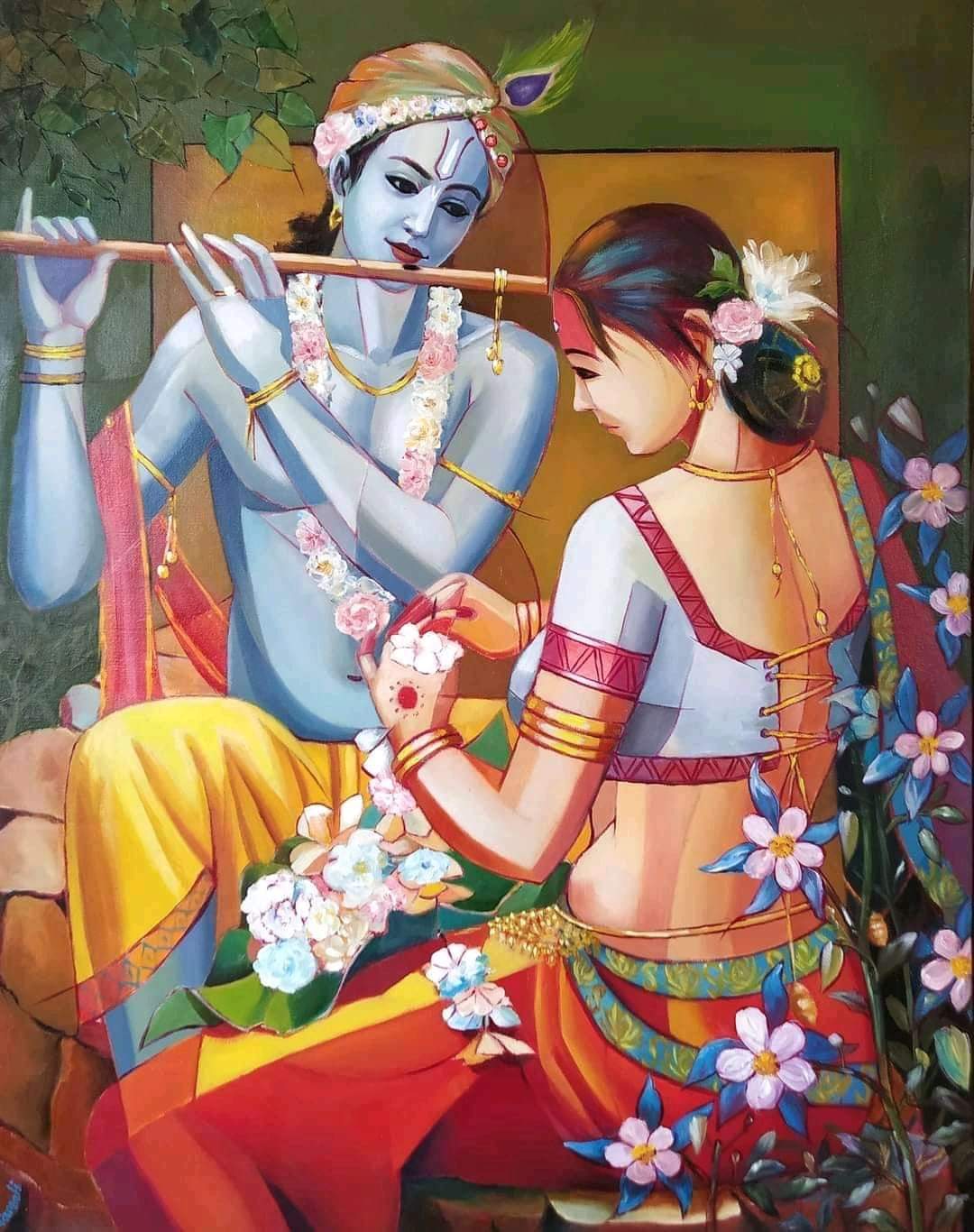
For even Krsna, love can NEVER exist when there is just "one", there MUST be "two" and they are -
Srimati Radharani and Krsna.
When Krsna wanted to experience loving emotions and affection He knew such love could never happen with just "one", or Him alone.
So Krsna divided Himself into "two" so He could experience loving exchanges.
Those two are the Divine couple Srimati Radharani and Krsna.
Srila Prabhupada - "When Krsna wants to be attracted by a woman, He has to create such a woman from His own energy. That woman is Rādhārāṇī.
It is explained by the Gosvāmīs that Rādhārāṇī is the manifestation of the pleasure potency of the Supreme Personality of Godhead.
When the Supreme Lord wants to derive transcendental pleasure, He has to create a woman from His internal potency and that women is Srimati Radharani" (Srimad Bhagavatam Canto 3 Chapter 31 text 38, Purport)
Sri Krsna - "Among the gopīs, You, Śrīmatī Rādhārāṇī, are the chief. Therefore You are the very life of My life and center of all Vṛndāvana’s activities".
Srila Prabhupada - "From Kṛṣṇa’s own statement given herein, it appears that Rādhārāṇī is the Queen of Vṛndāvana and that Kṛṣṇa is simply Her decoration. Kṛṣṇa is known as Madana-mohana, the enchanter of Cupid, but Śrīmatī Rādhārāṇī is the enchanter of Kṛṣṇa.
Consequently Śrīmatī Rādhārāṇī is called Madana-mohana-mohinī, the enchanter of the enchanter of Cupid". (Caitanya Caritamrta Madhya 13.150, Translation and Purport)
Srila Prabhupada - "Rādhā and Kṛṣṇa are "one and the same", but They have assumed two bodies. Thus They enjoy each other, tasting the mellows of love.
The two transcendentalists Rādhā and Kṛṣṇa are a puzzle to materialists. The description of Rādhā and Kṛṣṇa from the diary of Śrīla Svarūpa Dāmodara Gosvāmī is a condensed explanation, but one needs great spiritual insight to understand the mystery of these two personalities.
One is enjoying in two.
Śrī Kṛṣṇa is the potent factor, and Śrīmatī Rādhārāṇī is the internal potency.
According to Vedānta philosophy, there is no difference between the potent and the potency; they are identical.
We cannot differentiate between one and the other, any more than we can separate fire from heat.
Everything in the Absolute is inconceivable in relative existence. Therefore in relative cognizance it is very difficult to assimilate this truth of the oneness between the potent and the potency.
The philosophy of inconceivable oneness and difference propounded by Lord Caitanya is the only source of understanding for such intricacies of transcendence.
In fact, Rādhārāṇī is the internal potency of Śrī Kṛṣṇa, and She eternally intensifies the pleasure of Śrī Kṛṣṇa.
Impersonalists cannot understand this without the help of a mahā-bhāgavata devotee.
The very name “Rādhā” suggests that Śrīmatī Rādhārāṇī is eternally the topmost mistress of the comforts of Śrī Kṛṣṇa.
As such, She is the medium transmitting the living entities’ service to Śrī Kṛṣṇa.
Devotees in Vṛndāvana therefore seek the mercy of Śrīmatī Rādhārāṇī in order to be recognized as loving servitors of Śrī Kṛṣṇa". (Caitanya Caritamrita Adi 4.56, Translation and Purport)
Madhudviṣa Swami - "Śrīla Prabhupāda, you spoke of inferior energy and superior energy. Those are two general categories. Are there other categories of energies besides that, and specifically how could we understand Śrīmatī Rādhārāṇī Is She...?"
Srila Prabhupāda - "She is spiritual energy".
Madhudviṣa Swami - "But is She jīva-bhūta or?"
Srila Prabhupada - "No, no, no. She is Kṛṣṇa. If everything is Kṛṣṇa and Rādhārāṇī is not Kṛṣṇa, what is that? Kṛṣṇa. He (She) is Kṛṣṇa. She is the Kṛṣṇa's pleasure potency".
Madhudviṣa Swami - "She is not jīva?"
Srila Prabhupada - "No, no, no. She is Kṛṣṇa. Kṛṣṇa divided Himself into His energy and Himself. That energy, original spiritual energy, is Rādhārāṇī.
That is stated by Jīva Gosvāmī. Rādhā kṛṣṇa-praṇaya-vikṛtir hlādinī śaktir asmāt.
When Kṛṣṇa wants pleasure, He cannot accept the inferior energy.
The same superior energy, Kṛṣṇa, is divided into two. That is Rādhā and Kṛṣṇa.
And again, when they unite, that is Caitanya Mahāprabhu.
Divided, they are Rādhā and Kṛṣṇa, and united, Caitanya Mahāprabhu.
Śrī-kṛṣṇa-caitanya rādhā-kṛṣṇa nahe anya. Anya means another.
So Śrī Kṛṣṇa Caitanya is combination of Rādhā and Kṛṣṇa. And when they are divided into two, that is Rādhā and Kṛṣṇa.
This is the purport. Rādhā kṛṣṇa-praṇaya-vikṛtir hlādinī śaktir asmād ekātmānāv api bhuvi purā deha-bhedaṁ gatau tau, śrī-caitanyākhyaṁ prakaṭam adhunā tad-dvayaṁ caikyam āptam [Cc. Ādi 1.5].
These are the conclusion. Śrī Caitanya Mahāprabhu is Rādhā-Kṛṣṇa combination. But He is playing the part of Rādhārāṇī to understand Kṛṣṇa. This is Caitanya Mahāprabhu.
Rādhārāṇī is the chief gopī and all Her young girl friends, they are also gopīs. (Lecture on SB 2.1.1-5 -- Melbourne, June 26, 1974)
Srila Prabhupada - "Rādhikā is the transformation of Kṛṣṇa’s love. She is His internal energy called hlādinī". (Caitanya Caritamrita Adi 4.59, Translation)
Srila Prabhupada - "Radharani's mind, senses and body are steeped in love for Kṛṣṇa. She is Kṛṣṇa’s own energy, and She helps Him in His pastimes.
Śrīmatī Rādhārāṇī is as fully spiritual as Kṛṣṇa. No one should consider Her to be material.
She is definitely not like the conditioned souls, who have material bodies, gross and subtle, covered by material senses.
She is all-spiritual, and both Her body and Her mind are of the same spiritual embodiment.
Because Her body is spiritual, Her senses are also spiritual. Thus Her body, mind and senses fully shine in love of Kṛṣṇa.
She is the personified hlādinī-śakti (the pleasure-giving energy of the Lord’s internal potency), and therefore She is the only source of enjoyment for Śrī Kṛṣṇa.
Śrī Kṛṣṇa cannot enjoy anything that is internally different from Him. Therefore Rādhā and Śrī Kṛṣṇa are identical.
The sandhinī portion of Śrī Kṛṣṇa’s internal potency has manifested the all-attractive form of Śrī Kṛṣṇa, and the same internal potency, in the hlādinī feature, has presented Śrīmatī Rādhārāṇī, who is the attraction for the all-attractive.
No one can match Śrīmatī Rādhārāṇī in the transcendental pastimes of Śrī Kṛṣṇa". (Caitanya Caritamrta Adi 4.71, Translation and Purport)
Srila Prabhupada - "Just as the fountainhead, Lord Kṛṣṇa, is the cause of all incarnations, so Śrī Rādhā is the cause of all these consorts". (Caitanya Caritamrita Adi 4.76, Translation)
Srila Prabhupada - "Rādhā is the one who gives pleasure to Govinda, and She is also the enchantress of Govinda. She is the be-all and end-all of Govinda, and the crest jewel of all His consorts".(Caitanya Caritamrita Adi 4.82, Translation)
Srila Prabhupada - "The transcendental goddess Śrīmatī Rādhārāṇī is the direct counterpart of Lord Śrī Kṛṣṇa. She is the central figure for all the goddesses of fortune. She possesses all the attractiveness to attract the all-attractive Personality of Godhead. She is the primeval internal potency of the Lord". (Caitanya Caritamrta Adi 4.83, Translation)
Srila Prabhupada - "I have already explained the meaning of “sarva-lakṣmī.” Rādhā is the original source of all the goddesses of fortune". (Caitanya Caritamrta Adi 4.90, Translation)
Srila Prabhupada - "Śrī Rādhā is the full power, and Lord Kṛṣṇa is the possessor of full power. The two are not different, as evidenced by the revealed scriptures. The attitude of Śrīmatī Rādhārāṇī is the highest perfection of conjugal love". (Caitanya Caritamrta Adi 4.96, Translation)
Srila Prabhupada -"Caitanya’s heart was full of the feelings of Śrīmatī Rādhārāṇī, and His appearance resembled Hers. Svarūpa Dāmodara has explained His attitude as rādhā-bhāva-mūrti, the attitude of Rādhārāṇī.
One who engages in sense gratification on the material platform can hardly understand rādhā-bhāva, but one who is freed from the demands of sense gratification can understand it. Rādhā-bhāva must be understood from the Gosvāmīs, those who are actually controllers of the senses.
From such authorized sources it is to be known that the attitude of Śrīmatī Rādhārāṇī is the highest perfection of conjugal love, which is the highest of the five transcendental mellows, and it is the complete perfection of love of Kṛṣṇa". (Caitanya Caritamrta Adi 4.106, Purport)
Srila Prabhupada - "Viṣaya and āśraya are two very significant words relating to the reciprocation between Kṛṣṇa and His devotee.
The devotee is called the āśraya, and his beloved, Kṛṣṇa, is the viṣaya.
Different ingredients are involved in the exchange of love between the āśraya and viṣaya, which are known as vibhāva, anubhāva, sāttvika and vyabhicārī.
Vibhāva is divided into the two categories ālambana and uddīpana. Ālambana may be further divided into āśraya and viṣaya.
In the loving affairs of Rādhā and Kṛṣṇa, Rādhārāṇī is the āśraya feature and Kṛṣṇa the viṣaya.
The transcendental consciousness of the Lord tells Him, “I am Kṛṣṇa, and I experience pleasure as the viṣaya.
The pleasure enjoyed by Rādhārāṇī, the āśraya, is many times greater than the pleasure I feel.”
Therefore, to feel the pleasure of the āśraya category, Lord Kṛṣṇa appeared as Śrī Caitanya Mahāprabhu". (Caitanya Caritamrta Adi 4.135, Purport)
Srila Prabhupada - "Among the gopīs, Śrīmatī Rādhikā is the foremost. She surpasses all in beauty, in good qualities, in good fortune and, above all, in love.
Among all the gopīs, Śrīmatī Rādhārāṇī is the most exalted. She is the most beautiful, the most qualified and, above all, the greatest lover of Kṛṣṇa". (Caitanya Caritamrta Adi 4.214, Translation and Purport)
Srila Prabhupada - "Rādhā is the beloved consort of Kṛṣṇa, and She is the wealth of His life. Without Her, the gopīs cannot give Him pleasure". (Caitanya Caritamrta Adi 4.218, Translation)
Srila Prabhupada - "Distinguishing between pure devotees and internal or confidential devotees, Śrī Rūpa Gosvāmī, in his book Upadeśāmṛta, traces the following gradual process of development.
Out of many thousands of karmīs, one is better when he is situated in perfect Vedic knowledge.
Out of many such learned scholars and philosophers, one who is actually liberated from material bondage is better, and out of many such persons who are actually liberated, one who is a devotee of the Supreme Personality of Godhead is considered to be the best.
Among the many such transcendental lovers of the Supreme Personality of Godhead, the gopīs are the best, and among the gopīs Śrīmatī Rādhikā is the best.
Śrīmatī Rādhikā is very dear to Lord Kṛṣṇa, and similarly Her ponds, namely, Śyāma-kuṇḍa and Rādhā-kuṇḍa, are also very dear to the Supreme Personality of Godhead". (Caitanya Caritamrta Adi 7.18-19, Purport)
Srila Prabhupada - "Kṛṣṇa’s desire in the rāsa-līlā circle is perfectly complete, but Śrīmatī Rādhārāṇī is the binding link in that desire".(Caitanya Caritamrita Madhya-lila 8.113, Translation)
Srila Prabhupada - “The body of Śrīmatī Rādhārāṇī is a veritable transformation of love of Godhead; She is the dearmost friend of Kṛṣṇa, and this is known throughout the world". (Caitanya Caritamrta Madhya 8.162, Translation)
Srila Prabhupada - "That supreme ecstasy of Śrīmatī Rādhārāṇī is the essence of spiritual life. Her only business is to fulfill all the desires of Kṛṣṇa". (Caitanya Caritamrta Madhya 8.164, Translation)
Srila Prabhupada - "Śrīmatī Rādhārāṇī is the topmost spiritual gem, and the other gopīs—Lalitā, Viśākhā and so on-are expansions of Her spiritual body". (Caitanya Caritamrta Madhya 8.165, Translation)
Srila Prabhupada - "In his Amṛta pravāha bhāṣya, Śrīla Bhaktivinoda Ṭhākura states, “Śrīmatī Rādhārāṇī is the creeper of love of Godhead, and the gopīs are exactly like twigs, flowers and leaves.
When water is sprinkled on the creeper, the twigs, flowers and leaves indirectly receive all the benefits of the creeper itself.
But water sprinkled directly on the twigs, leaves and flowers is not as effective as water sprinkled on the creeper’s root.
The gopīs are not as pleased when they directly mix with Kṛṣṇa as when they serve to unite Śrīmatī Rādhārāṇī with Kṛṣṇa. Their transcendental pleasure lies in uniting Them.” Of all the gopīs, Śrīmatī Rādhārāṇī is the topmost". (Caitanya Caritamrta Madhya 8.210, Purport)
Srila Prabhupada - "In the Ādi Purāṇa the Supreme Personality of Godhead Himself says:
na tathā me priyatamo brahmā rudraś ca pārthiva
na ca lakṣmīr na cātmā ca yathā gopī-jano mama
“Lord Brahmā, Lord Śiva, the goddess of fortune and even My own self are not as dear to Me as the gopīs.”
Of all the gopīs, Śrīmatī Rādhārāṇī is the topmost. Rūpa Gosvāmī and Sanātana Gosvāmī are the most exalted servitors of Śrīmatī Rādhārāṇī and Lord Śrī Caitanya Mahāprabhu.
Those who adhere to their service are known as rūpānuga devotees". (Caitanya Caritamrta Madhya 8.246, Purport)
Srila Prabhupada - "Lord Śrī Kṛṣṇa is the reservoir of all pleasure, and Śrīmatī Rādhārāṇī is the personification of ecstatic love of Godhead.
These two forms had combined as one in Śrī Caitanya Mahāprabhu. This being the case, Lord Śrī Caitanya Mahāprabhu revealed His real form to Rāmānanda Rāya". (Caitanya Caritamrta Madhya 8.282, Translation)
Srila Prabhupada - “I have now converted My body and mind into the ecstasy of Śrīmatī Rādhārāṇī; thus I am tasting My own personal sweetness in that form.”
Gaurasundara here informed Śrī Rāmānanda Rāya, “My dear Rāmānanda Rāya, you were actually seeing a separate person with a fair-complexioned body.
Actually I am not fair. Being Śrī Kṛṣṇa, the son of Nanda Mahārāja, I am blackish, but when I come in touch with Śrīmatī Rādhārāṇī I become fair-complexioned externally.
Śrīmatī Rādhārāṇī does not touch the body of anyone but Kṛṣṇa. I taste My own transcendental features by accepting the complexion of Śrīmatī Rādhārāṇī.
Without Rādhārāṇī, one cannot taste the transcendental pleasure of Kṛṣṇa’s conjugal love.”
In this regard, Śrīla Bhaktisiddhānta Sarasvatī Ṭhākura comments on the prākṛta-sahajiyā-sampradāya, which considers Kṛṣṇa and Lord Caitanya to possess different bodies.
They misinterpret the words gaura aṅga nahe mora in text 287. From that verse and the present verse we can understand that Lord Caitanya Mahāprabhu is nondifferent from Kṛṣṇa.
Both are the same Supreme Personality of Godhead. In the form of Kṛṣṇa, the Lord enjoys spiritual bliss and remains the shelter of all devotees, viṣaya-vigraha.
And in His Gaurāṅga feature Kṛṣṇa tastes separation from Kṛṣṇa in the ecstasy of Śrīmatī Rādhārāṇī.
This ecstatic form is Śrī Kṛṣṇa Caitanya. Śrī Kṛṣṇa is always the transcendental reservoir of all pleasure, and He is technically called dhīra-lalita.
Śrīmatī Rādhārāṇī is the embodiment of spiritual energy, personified as ecstatic love for Kṛṣṇa; therefore only Kṛṣṇa can touch Her.
The dhīra-lalita aspect is not seen in any other form of the Lord, including Viṣṇu and Nārāyaṇa.
Śrīmatī Rādhārāṇī is therefore known as Govinda-nandinī and Govinda-mohinī, for She is the only source of transcendental pleasure for Śrī Kṛṣṇa and the only person who can enchant His mind". (Caitanya Caritamrta Madhya 8.288, Translation and Purport)
Srila Prabhupada - “My dearest Śrīmatī Rādhārāṇī, please hear Me. I am speaking the truth. I cry day and night simply upon remembering all you inhabitants of Vṛndāvana.
No one knows how unhappy this makes Me.” It is said: vṛndāvanaṁ parityajya padam ekaṁ na gacchati.
In one sense, Kṛṣṇa, the original Personality of Godhead (īśvaraḥ paramaḥ kṛṣṇaḥ sac cid ānanda vigrahaḥ [Bs. 5.1]), does not even take one step away from Vṛndāvana.
However, in order to take care of various duties, Kṛṣṇa had to leave Vṛndāvana.
He had to go to Mathurā to kill Kaṁsa, and then He was taken by His father to Dvārakā, where He was busy with state affairs and disturbances created by demons.
Kṛṣṇa was away from Vṛndāvana, and He was not at all happy, as He plainly disclosed to Śrīmatī Rādhārāṇī.
She is the dearmost life and soul of Śrī Kṛṣṇa, and He expressed His mind to Her as follows". (Caitanya Caritamrta Madhya 13.149, Translation and Purport)
Srila Prabhupada - "Śrī Kṛṣṇa continued: “All the inhabitants of Vṛndāvana-dhāma—My mother, father, cowherd boyfriends and everything else—are like My life and soul.
And among all the inhabitants of Vṛndāvana, the gopīs are My very life and soul. And among the gopīs, You, Śrīmatī Rādhārāṇī, are the chief. Therefore You are the very life of My life. Śrīmatī Rādhārāṇī is the center of all Vṛndāvana’s activities.
In Vṛndāvana, Kṛṣṇa is the instrument of Śrīmatī Rādhārāṇī; therefore all the inhabitants of Vṛndāvana still chant “Jaya Rādhe!”
From Kṛṣṇa’s own statement given herein, it appears that Rādhārāṇī is the Queen of Vṛndāvana and that Kṛṣṇa is simply Her decoration.
Kṛṣṇa is known as Madana-mohana, the enchanter of Cupid, but Śrīmatī Rādhārāṇī is the enchanter of Kṛṣṇa.
Consequently Śrīmatī Rādhārāṇī is called Madana-mohana-mohinī, the enchanter of the enchanter of Cupid". (Caitanya Caritamrta Madhya 13.150, Translation and Purport)
Srila Prabhupada - "Of all the gopīs, Śrīmatī Rādhārāṇī is the chief. She is a jewel mine of ecstatic love and the source of all purified transcendental conjugal mellows". (Caitanya Caritamrta Madhya 14.160, Translation)
Srila Prabhupada - "Of all the gopīs, Rādhārāṇī is the dearmost. Similarly, the lake known as Rādhā-kuṇḍa is very dear to the Lord because it is very dear to Śrīmatī Rādhārāṇī". (Caitanya Caritamrta Madhya 18.7, Translation)
Srila Prabhupada - "Lord Kṛṣṇa, the Supreme Personality of Godhead, who appeared as the son of Nanda Mahārāja, is the supreme hero in all dealings. Similarly, Śrīmatī Rādhārāṇī is the topmost heroine in all dealings". (Caitanya Caritamrta Madhya 23.66, Translation)
Srila Prabhupada - "The transcendental goddess Śrīmatī Rādhārāṇī is the direct counterpart of Lord Śrī Kṛṣṇa.
She is the central figure for all the goddesses of fortune. She possesses all the attraction to attract the all-attractive Personality of Godhead. She is the primeval internal potency of the Lord". (Caitanya Caritamrta Madhya 23.68, Translation)
Srila Prabhupada - "Śrīmatī Rādhārāṇī is the Ganges in which the elephant of My mind enjoys pastimes. She is the shining of the full autumn moon for the cakora birds of My eyes.
She is the dazzling ornament, the bright and beautiful arrangement of stars, on the border of the sky of My chest.
Now today I have gained Śrīmatī Rādhārāṇī because of the highly elevated state of My mind". (Caitanya Caritamrita Antya 1.191, Translation)
Srila Prabhupada - "Kṛṣṇa and Rādhārāṇī are both transcendentally qualified, and both of Them attract one another. Yet in that transcendental attraction, Rādhārāṇī is greater than Kṛṣṇa, for the attractiveness of Rādhārāṇī is the transcendental taste in conjugal love.
Similarly, there are transcendental tastes in servitude, friendship and other relationships with Kṛṣṇa.
Rādhārāṇī is the only gopī who is dearer to Kṛṣṇa than all the other gopīs". (Teachings of Lord Caitanya, Chapter 14, Purport)
Srila Prabhupada - "Lord Caitanya exhibited the mode of Śrīmatī Rādhārāṇī when She was contacted from Dvārakā by Śrī Kṛṣṇa.
Such transcendental love is not possible for any common man; therefore one should not imitate the highest perfectional stage exhibited by Caitanya Mahāprabhu.
If, however, one desires to be in that association, he may follow in the footsteps of the gopīs.
In the Padma Purāṇa it is stated that just as Rādhārāṇī is dear to Kṛṣṇa, similarly the kuṇḍa known as Rādhākuṇḍa is also very dear to Him. Rādhārāṇī is the only gopī who is dearer to Kṛṣṇa than all the other gopīs.
In Śrīmad-Bhāgavatam (10.30.28) it is also stated that Rādhārāṇī and the gopīs render the highest perfectional loving service to the Lord and that the Lord is so pleased with them that He does not wish to leave the company of Śrīmatī Rādhārāṇī". (Teachings of Lord Caitanya, Chapter 30)
Srila Prabhupada - "As Kṛṣṇa is the highest emblem of spiritual perfection, so Rādhārāṇī is the highest emblem of that spiritual pleasure potency by which Kṛṣṇa is satisfied.
Since Kṛṣṇa is unlimited, in order to satisfy Him Rādhārāṇī is also unlimited. Kṛṣṇa is satisfied just by seeing Rādhārāṇī, but Rādhārāṇī expands Herself in such a way that Kṛṣṇa desires to enjoy Her more.
Because Kṛṣṇa was unable to estimate the pleasure potency of Rādhārāṇī, He decided to accept the role of Rādhārāṇī, and that combination is Śrī Caitanya Mahāprabhu". (Teachings of Lord Caitanya, Chapter 31)
Srila Prabhupada - "The actual form of Rādhārāṇī is just like a creeper embracing the tree of Kṛṣṇa, and the damsels of Vraja, the associates of Rādhārāṇī, are just like the leaves and flowers of that creeper.
When a creeper embraces a tree, the leaves and flowers as well as the creeper automatically embrace it. Govinda-līlāmṛta (10.16) confirms that Rādhārāṇī is the expansion of the pleasure potency of Kṛṣṇa and is compared with a creeper, and Her associates, the damsels of Vraja, are compared to the flowers and leaves of that creeper.
When Rādhārāṇī and Kṛṣṇa enjoy Themselves, the damsels of Vraja relish the pleasure more than Rādhārāṇī Herself". (Teachings of Lord Caitanya, Chapter 31)
Srila Prabhupada - "The fact is that both Kṛṣṇa and Lord Caitanya are the original Personality of Godhead.
No one should try to eliminate Lord Caitanya from Śrī Kṛṣṇa.
In His form of Śrī Kṛṣṇa, He is the supreme enjoyer, and in His form of Lord Caitanya, He is the supreme enjoyed.
No one can be more superexcellently attractive than Śrī Kṛṣṇa, and but for Śrī Kṛṣṇa, no one can enjoy the supreme form of devotion, Śrīmatī Rādhārāṇī. But for Śrī Kṛṣṇa, all Viṣṇu forms are lacking this ability.
This is explained in the description of Govinda in Caitanya-caritāmṛta. There it is said that Śrīmatī Rādhārāṇī is the only personality who can infuse Śrī Kṛṣṇa with transcendental pleasure.
Thus Śrīmatī Rādhārāṇī is the chief damsel of Vraja in love with Govinda, the Supreme Personality of Godhead, Śrī Kṛṣṇa". (Teachings of Lord Caitanya, Chapter 32)
Srila Prabhupada - "In the Gīta-govinda, by Jayadeva Gosvāmī, one gopī tells her friend, "Kṛṣṇa is the reservoir of all pleasure within this universe. His body is as soft as the lotus flower.
And His free behavior with the gopīs, which appears exactly like a young boy's attraction to a young girl, is a subject matter of transcendental conjugal love."
A pure devotee follows in the footsteps of the gopīs and worships the gopīs as follows -
"Let me offer my respectful obeisances to all the young cowherd girls, whose bodily features are so attractive. Simply by their beautiful attractive features they are worshiping the Supreme Personality of Godhead, Kṛṣṇa."
Out of all the young gopīs, Śrīmatī Rādhārāṇī is the most prominent". (Nectar of Devotion 44)
Srila Prabhupada - "The gopīs are exalted above all the advanced devotees because they are always totally dependent upon Śrī Kṛṣṇa, the transcendental cowherd boy.
Among the gopīs, Śrīmatī Rādhārāṇī is the most dear to Kṛṣṇa. Her kuṇḍa [lake] is as profoundly dear to Lord Kṛṣṇa as this most beloved of the gopīs.
Who, then, will not reside at Rādhā-kuṇḍa and, in a spiritual body surcharged with ecstatic devotional feelings [aprākṛtabhāva], render loving service to the divine couple Śrī Śrī Rādhā-Govinda, who perform Their aṣṭakālīya-līlā, Their eternal eightfold daily pastimes.
Indeed, those who execute devotional service on the banks of Rādhā-kuṇḍa are the most fortunate people in the universe.
Śrīmatī Rādhārāṇī is the most exalted devotee of Kṛṣṇa". (Nectar of Instruction 10, Translation)
Srila Prabhupada - "When Kṛṣṇa left Vṛndāvana for Mathurā, the gopīs became most dejected and spent the rest of their lives simply crying in separation from Kṛṣṇa.
This means that in one sense they were never actually separated from Kṛṣṇa. There is no difference between thinking of Kṛṣṇa and associating with Him.
Rather, vipralambha-sevā, thinking of Kṛṣṇa in separation, as Śrī Caitanya Mahāprabhu did, is far better than serving Kṛṣṇa directly.
Thus of all the devotees who have developed unalloyed devotional love for Kṛṣṇa, the gopīs are most exalted, and out of all these exalted gopīs, Śrīmatī Rādhārāṇī is the highest. No one can excel the devotional service of Śrīmatī Rādhārāṇī.
Indeed, even Kṛṣṇa cannot understand the attitude of Śrīmatī Rādhārāṇī; therefore He took Her position and appeared as Śrī Caitanya Mahāprabhu, just to understand Her transcendental feelings.
In this way Śrīla Rūpa Gosvāmī gradually concludes that Śrīmatī Rādhārāṇī is the most exalted devotee of Kṛṣṇa and that Her kuṇḍa (lake), Śrī Rādhā-kuṇḍa, is the most exalted place". (Nectar of Instruction 10, Purport)
Srila Prabhupada - "Of the many objects of favored delight and of all the lovable damsels of Vrajabhūmi, Śrīmatī Rādhārāṇī is certainly the most treasured object of Kṛṣṇa's love.
And, in every respect, Her divine kuṇḍa is described by great sages as similarly dear to Him.
Undoubtedly Rādhā-kuṇḍa is very rarely attained even by the great devotees; therefore it is even more difficult for ordinary devotees to attain.
If one simply bathes once within those holy waters, one's pure love of Kṛṣṇa is fully aroused.
Why is Rādhā-kuṇḍa so exalted? The lake is so exalted because it belongs to Śrīmatī Rādhārāṇī, who is the most beloved object of Śrī Kṛṣṇa.
Among all the gopīs, She is the most beloved. Similarly, Her lake, Śrī Rādhā-kuṇḍa, is also described by great sages as the lake that is as dear to Kṛṣṇa as Rādhā Herself.
Indeed, Kṛṣṇa's love for Rādhā-kuṇḍa and Śrīmatī Rādhārāṇī is the same in all respects.
Rādhā-kuṇḍa is very rarely attained, even by great personalities fully engaged in devotional service, not to speak of ordinary devotees who are only engaged in the practice of vaidhī bhakti". (Nectar of Instruction 11, Translation and Purport)
Srila Prabhupada - "Rādhārāṇī and Candrāvalī are even more prominent, and out of these two gopīs, Rādhārāṇī is the most prominent". (Krsna Book, The Supreme Personality of Godhead)
Srila Prabhupada - "We understand from the Brahma-saṁhitā and Skanda Purāṇa that Kṛṣṇa is always surrounded by many thousands of goddesses of fortune.
The gopīs are all goddesses of fortune, and Kṛṣṇa took them hand in hand on the bank of the Yamunā. It is said in the Skanda Purāṇa that out of many thousands of gopīs, 16,000 are prominent, out of those 16,000, 108 are especially prominent.
Out of these 108 gopīs, eight gopīs are still more prominent, out of those eight gopīs, Rādhārāṇī and Candrāvalī are even more prominent, and out of these two gopīs, Rādhārāṇī is the most prominent". (Krsna Book 32)
Srila Prabhupada - "So Kṛṣṇa left Vṛndāvana. All the gopīs, they passed their days simply crying for Kṛṣṇa, but never condemned Kṛṣṇa.
Whenever somebody came... Kṛṣṇa also was thinking of them because gopīs are the greatest devotees, topmost devotees.
There is no comparison with the devotion of the gopīs. Therefore Kṛṣṇa was always obliged to them. Kṛṣṇa said to the gopīs that "You have to be satisfied with your own business.
I cannot return you anything for your love." Kṛṣṇa, the Supreme, the all-powerful, He was unable to repay the debts for the gopīs.
Caitanya Mahāprabhu said, ramyā kācid upāsanā vraja-vadhu-vargeṇa yā kalpitā. There is no more better worship than what was conceived by the gopīs.
So gopīs are the topmost devotees. And amongst the gopīs, Śrīmatī Rādhārāṇī is the topmost. Therefore Śrīmatī Rādhārāṇī is greater than Kṛṣṇa". (Lecture on BG 2.3 -- London, August 4, 1973)
Guest - "We are expansions of Rādhā?"
Srila Prabhupada - "No. Rādhā is the internal potency, we are marginal potency. Of course, originally, in that sense, everything is Kṛṣṇa's expansion. Sarvaṁ khalv idaṁ brahma.
But even there are expansions... That is the difference between Māyāvāda philosophy and Vaiṣṇava philosophy.
Caitanya Mahāprabhu...acintya-bhedābheda. We are always simultaneously one and different. Always.
We should remember. We are expansion of Kṛṣṇa, we are expansion of Rādhā also because Rādhā is also expansion of Kṛṣṇa. But still, different.
That is the philosophy. One and different simultaneously. Acintya-bhedābheda.
Caitanya Mahāprabhu's philosophy is inconceivable simultaneously one and different.
This is explained in the Seventh Chapter of Bhagavad-gītā. The energies and the energetic is the same. Śakti-śaktimator abheda.
Just like sun and the sunshine, they are the same. There is no difference. But the molecules of the sunshine particles, that is not equal to the sun.
These truths we shall always remember. Acintyāḥ khalu ye bhāvāḥ. Therefore these are inconceivable.
We are simultaneously one with Kṛṣṇa and Rādhā, and at the same time different". (Lecture on BG 4.5 -- Montreal, June 10, 1968)
This Rādhārāṇī is the source of spiritual inspiration.
Srila Prabhupada - "So today is Śrīmatī Rādhārāṇī's birthday, Rādhāṣṭamī. So we called you for meeting.
This Rādhārāṇī, about some, Rādhārāṇī... Because this Rādhārāṇī is the source of spiritual inspiration. Source of spiritual inspiration.
Apareyam itas tu viddhi me prakṛtiṁ parām, jīva-bhūtāṁ mahā-bāho... Prakṛtiṁ parām [Bg. 7.5].
The aparā-prakṛti is this material world, bhūmir āpo 'nalo vāyuḥ [Bg. 7.4].
And there is another prakṛti, parā-prakṛti. That is also mentioned here: mad-bhāvam. Mad-bhāvam means the nature in which Kṛṣṇa is there.
In this material nature, although Kṛṣṇa is there, but we do not understand. We cannot see Kṛṣṇa. That is material, forgetfulness of Kṛṣṇa. But when you remember Kṛṣṇa even in this material world, then it becomes spiritual.
So we shall pray to Rādhārāṇī... What is Rādhārāṇī? Rādhārāṇī is the pleasure potency of Kṛṣṇa". (Lecture on BG 4.10 -- Calcutta, September 23, 1974)
Srila Prabhupada - "If, if we remain just like cats and dogs, eat, sleep and have sex life, beget children and die someday, this is cats' and dogs' life.
This is not human life. Human life is different. Man-mayā mām upāśritāḥ. Jñāna-tapasā pūtā. To become purified by knowledge and tapasya. Tapo divyaṁ yena śuddhyet sattvam [SB 5.5.1]
That is the statement of Ṛṣabhadeva. Everywhere. We have to purify our existence, and get out of this repetition of birth and death. That is success of life". (Lecture on BG 4.10 -- Calcutta, September 23, 1974)
So we shall pray to Rādhārāṇī. What is Rādhārāṇī? Rādhārāṇī is the pleasure potency of Kṛṣṇa.
Parāsya śaktir vividhaiva śrūyate [Cc. Madhya 13.65, purport].
The Supreme Lord has many potencies. Na tasya kāryam karaṇaṁ ca vidyate.
Therefore He has nothing to do. He has got so many potencies. Just like big man, a rich man. He's sitting. But his energies, his potencies, are working. Big, big factory.
And he knows everything. Similarly, parāsya śaktir vividhaiva śrūyate. He has got many multi-potencies. One of them is this pleasure potency". (Lecture on BG 4.10 -- Calcutta, September 23, 1974)
Srila Prabhupada - "So our business is that we have to take shelter. Instead of taking shelter of the external energy... That is also Kṛṣṇa.
There is no doubt. Kṛṣṇa, Kṛṣṇa's energy: nondifferent. But that is not very beneficial to us.
We have to take shelter of the internal energy. Mahātmānas tu māṁ pārtha daivīṁ prakṛtim āśritāḥ [Bg. 9.13].
Daivīṁ prakṛtim means internal energy. And Śrīmatī Rādhārāṇī is the, mean, the symbol of internal energy.
Therefore we take shelter of Śrīmatī Rādhārāṇī in Vṛndāvana, and that is our perfection of life. Then it will be easier to associate with Kṛṣṇa very easily. That should be our motto". (Lecture on BG 4.11 -- Vrndavana, August 3, 1974)
Srila Prabhupada - "Yaṁ śyāmasundaram. Kṛṣṇa's another name is Śyāmasundara. He's blackish, but very beautiful.
Generally, we don't like to see blackish people. But Kṛṣṇa is so nice. Although He's blackish, He's kandarpa-koṭi-kamanīya.
Barhāvataṁsam asitāmbuda-sundarāṅgam. These are described in the Vedic literature.
Although He's blackish, He is more beautiful than millions of millions of cupids. Kandarpa-koṭi-kamanīya. So Kṛṣṇa is so beautiful. That is His Godliness.
Kṛṣṇa is the most beautiful, Rādhārāṇī is the most beautiful. Couple, young couple.
Our object of worship when we see how nice Rādhārāṇī, how nice Kṛṣṇa, beauty. Yes". (Lecture on BG 13.19 -- Bombay, October 13, 1973)
Srila Prabhupada - "Just like Kṛṣṇa's another name is Madana-mohana. Madana means Cupid. Cupid enchants everyone. Cupid. And Kṛṣṇa enchants Cupid.
Therefore His name is Madana-mohana. He's so beautiful that even Cupid is enchanted by Him. But again on the other side, Kṛṣṇa, although He's so beautiful that He enchants the Cupid, still He is enchanted by Śrīmatī Rādhārāṇī.
Therefore Śrīmatī Rādhārāṇī's name is Madana-mohana-mohinī. Kṛṣṇa is the enchanter of the Cupid, and Rādhārāṇī is the enchanter of that enchanter.
So these are very high-grade spiritual understanding in Kṛṣṇa consciousness.
It is not fiction or imagination, concoction. They are facts. They are facts. And every devotee can have such privileges if he is actually advanced". (Lecture on SB 1.8.31 -- Los Angeles, April 23, 1973)
Srila Prabhupada - "So Kṛṣṇa expands. Ekaṁ bahu syām. Expands. Ānanda-cinmaya-rasa-pratibhāvitābhis tābhir ya eva nija-rūpatayā kalābhiḥ [Bs. 5.37].
Kṛṣṇa expands His energy, ānanda-cinmaya-rasa. Rasa, humor, mellows, to enjoy, He expands Himself.
Just like Śrī Svarūpa Dāmodara Gosvāmī has given us the definition, Rādhā-Kṛṣṇa and Śrī Caitanya Mahāprabhu.
rādhā kṛṣṇa-praṇaya-vikṛtir hlādinī śaktir asmād ekātmānāv api bhuvi purā deha-bhedaṁ gatau tau
caitanyākhyaṁ prakaṭam adhunā tad-dvayaṁ caikyam āptaṁ
rādhā-bhāva-dyuti-suvalitaṁ naumi kṛṣṇa-svarūpam
[Cc. Ādi 1.5]
Rādhā and Kṛṣṇa, the same Absolute, but Rādhārāṇī is the expansion of the pleasure potency of Kṛṣṇa.
We have got potency as Kṛṣṇa has got. Parāsya śaktir vividhaiva śrūyate [Cc. Madhya 13.65, purport].
This is the Vedic injunction. Parā, they say. Absolute Truth has many potencies, innumerable, vividhaiva śrūyate.
One of the potencies is the pleasure potency. Just like we want some pleasure. Pleasure is the constitutional position of spirit soul, or the Absolute Truth. Ānandamayo 'bhyāsāt (Vedānta-sūtra 1.1.12).
God and we, being of the same quality, we are by nature always joyful. So our joyfulness is checked when we are in material condition.
Therefore there is struggle. We are hankering after, to revive that joyfulness, but this contamination of material energy, sattva-guṇa, rajo-guṇa, tamo-guṇa, they are checking, obstacles.
Just like Rādhārāṇī and the gopīs. They are on the same status, but the gopīs know that "Rādhārāṇī is the better worshiper than us." (Lecture on SB 1.10.7 -- Mayapura, June 22, 1973)
Srila Prabhupada - "Just like in the material world, everyone is envious. If I become richer than you, then you become envious, that
"Oh, how this man has become richer? We are in the same business."
So this is material. There is no appreciation. But in the Vaikuṇṭha world there is comparative devotional service.
Just like Rādhārāṇī and the gopīs. They are on the same status, but the gopīs know that "Rādhārāṇī is the better worshiper than us."
Therefore their only business is how to take Rādhārāṇī and join with Kṛṣṇa. This is Vaikuṇṭha understanding. They are not envious that "Kṛṣṇa loves Rādhārāṇī so much," and they are envious. No, no, not at all. They want it that "Kṛṣṇa loves Rādhārāṇī so much, and Rādhārāṇī loves..."
They simply try to join Them. And they are happy, "Oh, Kṛṣṇa and Rādhārāṇī is now joined together." That is their happiness.
This is Vaikuṇṭha appreciation.
If everything is Kṛṣṇa and Rādhārāṇī is not Kṛṣṇa, what is that? Kṛṣṇa. He (She) is Kṛṣṇa. She is the Kṛṣṇa's pleasure potency". (Lecture on SB 2.1.1 -- Delhi, November 4, 1973)
Madhudviṣa Swami - "Śrīla Prabhupāda, you spoke of inferior energy and superior energy. Those are two general categories. Are there other categories of energies besides that, and specifically how could we understand Śrīmatī Rādhārāṇī? Is She..."
Srila Prabhupāda - "She is spiritual energy".
Madhudviṣa Swami - "But is She jīva-bhūta or?"
Srila Prabhupada - "No, no, no. She is Kṛṣṇa. If everything is Kṛṣṇa and Rādhārāṇī is not Kṛṣṇa, what is that? Kṛṣṇa. He (She) is Kṛṣṇa. She is the Kṛṣṇa's pleasure potency".
Madhudviṣa Swami - "She is not jīva?"
Srila Prabhupada - "No, no, no. She is Kṛṣṇa. Kṛṣṇa divided Himself into His energy and Himself. That energy, original spiritual energy, is Rādhārāṇī.
That is stated by Jīva Gosvāmī. Rādhā kṛṣṇa-praṇaya-vikṛtir hlādinī śaktir asmāt. When Kṛṣṇa wants pleasure, He cannot accept the inferior energy.
The same superior energy, Kṛṣṇa, is divided into two. That is Rādhā and Kṛṣṇa.
And again, when they unite, that is Caitanya Mahāprabhu. Divided, they are Rādhā and Kṛṣṇa, and united, Caitanya Mahāprabhu.
Śrī-kṛṣṇa-caitanya rādhā-kṛṣṇa nahe anya. Anya means another. So Śrī Kṛṣṇa Caitanya is combination of Rādhā and Kṛṣṇa.
And when they are divided into two, that is Rādhā and Kṛṣṇa.
This is the purport. Rādhā kṛṣṇa-praṇaya-vikṛtir hlādinī śaktir asmād ekātmānāv api bhuvi purā deha-bhedaṁ gatau tau, śrī-caitanyākhyaṁ prakaṭam adhunā tad-dvayaṁ caikyam āptam [Cc. Ādi 1.5].
These are the conclusion. Śrī Caitanya Mahāprabhu is Rādhā-Kṛṣṇa combination. But He is playing the part of Rādhārāṇī to understand Kṛṣṇa. This is Caitanya Mahāprabhu.
Rādhārāṇī is the chief gopī and all Her young girl friends, they are also gopīs. (Lecture on SB 2.1.1-5 -- Melbourne, June 26, 1974)
Pradyumna - "The goddess of fortune in her transcendental form is engaged in the loving service of the Lord's lotus feet, and being moved by the black bees, followers of spring, she is not only engaged in variegated pleasure-service to the Lord, along with her constant companions, but also she is engaged in singing the glories of the Lord's activities." [SB 2.9.14]
Srila Prabhupāda - "So this is not impersonal, the actual description of the spiritual world, all personal varieties.
There are the bees, there are goddess of fortune, and followed by her associate, and there is service and so many things, all opulences, śrī. Śrīr yasya. Aiśvaryasya ṣriyaḥ yaśasaḥ.
The definition of the Lord is given that He's full of beauties. In the Brahma-saṁhitā also, Lakṣmī. And not only one, all of them are lakṣmīs.
The associates of Lakṣmī, the maidservants of Lakṣmī, they are also lakṣmīs. They are not ordinary women, just like Rādhārāṇī is the chief gopī and all Her young girl friends, they are also gopīs.
They are of the same category. Ānanda-cinmaya-rasa-pratibhāvitābhiḥ [Bs. 5.37]. They are all expansion of Kṛṣṇa, pleasure potency.
So this is the information of the Vaikuṇṭhaloka or Goloka Vṛndāvana". (Lecture on SB 2.9.14 -- Melbourne, April 13, 1972)+