Srila Prabhupada - "Balarāma is a svāṁśa (unlimited potencies) expansion of Lord Krsna, and therefore there is no difference in potency between Kṛṣṇa and Balarām. The only difference is in Their bodily structure".
Caitanya Caritamrita Adi Lila Chapter 5 Part 1, Text 1 to text 30
By His Divine Grace AC Bhaktivedanta Swami Prabhupada.
The Glories of Lord Nityānanda Balarāma
This chapter is chiefly devoted to describing the essential nature and glories of Śrī Nityānanda Prabhu.
Lord Śrī Kṛṣṇa is the absolute Personality of Godhead, and His first expansion in a form for pastimes is Śrī Balarāma.
Beyond the limitation of this material world is the spiritual sky, paravyoma, which has many spiritual planets, the supreme of which is called Kṛṣṇaloka.
Kṛṣṇaloka, the abode of Kṛṣṇa, has three divisions, which are known as
1 - Dvārakā,
2 - Mathurā,
3 - Gokula.
In Gokula the Personality of Godhead expands Himself into four plenary portions-
1 - Kṛṣṇa,
2 - Balarāma,
3 - Pradyumna (the transcendental Cupid)
4 - Aniruddha.
They are known as the original quadruple forms.
In Kṛṣṇaloka is a transcendental place known as Śvetadvīpa or Vṛndāvana. Below Kṛṣṇaloka in the spiritual sky are the Vaikuṇṭha planets.
On each Vaikuṇṭha planet a four-handed Nārāyaṇa, expanded from the first quadruple manifestation, is present.
The Personality of Godhead known as Śrī Balarāma in Kṛṣṇaloka is the original Saṅkarṣaṇa (attracting Deity), and from this Saṅkarṣaṇa expands another Saṅkarṣaṇa, called Mahā-saṅkarṣaṇa, who resides in one of the Vaikuṇṭha planets.
By His internal potency, Mahā-saṅkarṣaṇa maintains the transcendental existence of all the planets in the spiritual sky, where all the living beings are eternally liberated souls.
The influence of the material energy is conspicuous there by its absence. On those planets the second quadruple manifestation is present.
Outside of the Vaikuṇṭha planets is the impersonal manifestation of Śrī Kṛṣṇa, which is known as the Brahmaloka.
On the other side of the Brahmaloka is the spiritual kāraṇa-samudra, or Causal Ocean. The material energy exists on the other side of the Causal Ocean, without touching it.
In the Causal Ocean is Mahā-Viṣṇu, the original puruṣa expansion from Saṅkarṣaṇa.
This Mahā-Viṣṇu places His glance over the material energy, and by a reflection of His transcendental body He amalgamates Himself within the material elements.
As the source of the material elements, the material energy is known as pradhāna, and as the source of the manifestations of the material energy it is known as māyā.
But material nature is inert in that she has no independent power to do anything.
She is empowered to make the cosmic manifestation by the glance of Mahā-Viṣṇu. Therefore the material energy is not the original cause of the material manifestation.
Rather, the transcendental glance of Mahā-Viṣṇu over material nature produces that cosmic manifestation.
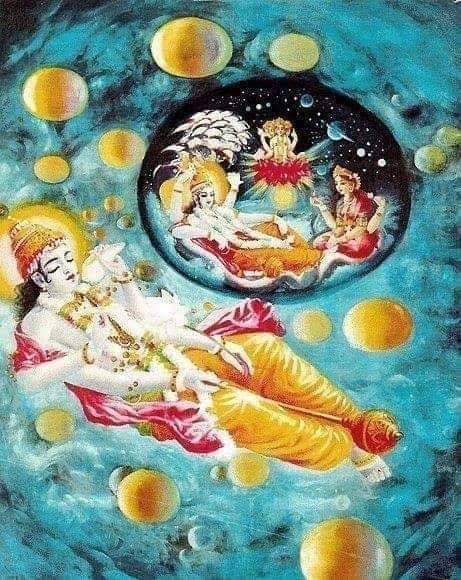
Mahā-Viṣṇu again enters every universe as the reservoir of all living entities, Garbhodakaśāyī Viṣṇu.
From Garbhodakaśāyī Viṣṇu expands Kṣīrodakaśāyī Viṣṇu, the Supersoul of every living entity.
Garbhodakaśāyī Viṣṇu also has His own Vaikuṇṭha planet in every universe, where He lives as the Supersoul or supreme controller of the universe.
Garbhodakaśāyī Viṣṇu reclines in the midst of the watery portion of the universe and generates the first living creature of the universe, Brahmā.
The imaginary universal form is a partial manifestation of Garbhodakaśāyī Viṣṇu.
In the Vaikuṇṭha planet in every universe is an ocean of milk, and within that ocean is an island called Śvetadvīpa, where Lord Viṣṇu lives.
Therefore this chapter describes two Śvetadvīpas-one in the abode of Kṛṣṇa and the other in the ocean of milk in every universe.
The Śvetadvīpa in the abode of Kṛṣṇa is identical with Vṛndāvana-dhāma, which is the place where Kṛṣṇa appears Himself to display His loving pastimes.
In the Śvetadvīpa within every universe is a Śeṣa form of Godhead who serves Viṣṇu by assuming the form of His umbrella, slippers, couch, pillows, garments, residence, sacred thread, throne and so on.
Lord Baladeva in Kṛṣṇaloka is Nityānanda Prabhu.
Therefore Nityānanda Prabhu is the original Saṅkarṣaṇa, and Mahā-saṅkarṣaṇa and His expansions as the puruṣas in the universes are plenary expansions of Nityānanda Prabhu.
In this chapter the author has described the history of his leaving home for a personal pilgrimage to Vṛndāvana and his achieving all success there.
In this description it is revealed that the author's original paternal home and birthplace were in the district of Katwa, in the village of Jhāmaṭapura, which is near Naihāṭī.
Kṛṣṇadāsa Kavirāja's brother invited Śrī Mīnaketana Rāmadāsa, a great devotee of Lord Nityānanda, to his home, but a priest named Guṇārṇava Miśra did not receive him well, and Kṛṣṇadāsa Kavirāja Gosvāmī's brother, not recognizing the glories of Lord Nityānanda, also took sides with the priest.
Therefore Rāmadāsa became sorry, broke his flute and went away. This was a great disaster for the brother of Kṛṣṇadāsa Kavirāja Gosvāmī.
But on that very night Lord Nityānanda Prabhu Himself graced Kṛṣṇadāsa Kavirāja Gosvāmī in a dream and ordered him to leave on the next day for Vṛndāvana.
TEXT 1
Let me offer my obeisances to Lord Śrī Nityānanda, the Supreme Personality of Godhead, whose opulence is wonderful and unlimited. By His will, even a fool can understand His identity.
TEXT 2
All glories to Śrī Caitanya Mahāprabhu. All glories to Lord Nityānanda. All glories to Advaita Ācārya. And all glories to all the devotees of Lord Caitanya Mahāprabhu.
TEXT 3
I have described the glory of Śrī Kṛṣṇa Caitanya in six verses. Now, in five verses, I shall describe the glory of Lord Nityānanda.
TEXT 4
The Supreme Personality of Godhead, Kṛṣṇa, is the fountainhead of all incarnations. Lord Balarāma is His second body.
PURPORT
Lord Śrī Kṛṣṇa, the absolute Personality of Godhead, is the primeval Lord, the original form of Godhead, and His first expansion is Śrī Balarāma.
The Personality of Godhead can expand Himself in innumerable forms.
The forms that have unlimited potency are called "svāṁśa", and forms that have limited potencies (the living entities) are called "vibhinnāṁśa".
TEXT 5
They are both one and the same identity. They differ only in form. He is the first bodily expansion of Kṛṣṇa, and He assists in Lord Kṛṣṇa's transcendental pastimes.
PURPORT
Balarāma is a svāṁśa (unlimited potencies) expansion of the Lord, and therefore there is no difference in potency between Kṛṣṇa and Balarām.
The only difference is in Their bodily structure.
As the first expansion of Godhead, Balarāma is the chief Deity among the first quadruple forms, and He is the foremost assistant of Śrī Kṛṣṇa in His transcendental activities.
TEXT 6
That original Lord Kṛṣṇa appeared in Navadvīpa as Lord Caitanya, and Balarāma appeared with Him as Lord Nityānanda.
TEXT 7
May Śrī Nityānanda Rāma be the object of my constant remembrance. Saṅkarṣaṇa, Śeṣa Nāga and the Viṣṇus who lie on the Kāraṇa Ocean, Garbha Ocean and ocean of milk are His plenary portions and the portions of His plenary portions.
PURPORT
Śrī Svarūpa Dāmodara Gosvāmī has recorded this verse in his diary to offer his respectful obeisances to Lord Nityānanda Prabhu.
This verse also appears as the seventh of the first fourteen verses of Śrī Caitanya-caritāmṛta.
TEXT 8
Lord Balarāma is the original Saṅkarṣaṇa. He assumes five other forms to serve Lord Kṛṣṇa.
TEXT 9
He Himself helps in the pastimes of Lord Kṛṣṇa, and He does the work of creation in four other forms.
TEXT 10
He executes the orders of Lord Kṛṣṇa in the work of creation, and in the form of Lord Śeṣa He serves Kṛṣṇa in various ways.
PURPORT
According to expert opinion, Balarāma, as the chief of the original quadruple forms, is also the original Saṅkarṣaṇa.
Balarāma, the first expansion of Kṛṣṇa, expands Himself in five forms:
1 - Mahā-saṅkarṣaṇa,
2 - Kāraṇābdhiśāyī,
3 - Garbhodakaśāyī,
5 - Śeṣa.
These five plenary portions are responsible for both the spiritual and material cosmic manifestations. In these five forms Lord Balarāma assists Lord Kṛṣṇa in His activities.
The first four of these forms are responsible for the cosmic manifestations, whereas Śeṣa is responsible for personal service to the Lord. Śeṣa is called Ananta, or unlimited, because He assists the Personality of Godhead in His unlimited expansions by performing an unlimited variety of services.
Śrī Balarāma is the servitor Godhead who serves Lord Kṛṣṇa in all affairs of existence and knowledge.
Lord Nityānanda Prabhu, who is the same servitor Godhead, Balarāma, performs the same service to Lord Gaurāṅga by constant association.
TEXT 11
In all the forms He tastes the transcendental bliss of serving Kṛṣṇa. That same Balarāma is Lord Nityānanda, the companion of Lord Gaurasundara.
TEXT 12
I have explained this seventh verse in four subsequent verses. By these verses all the world can know the truth about Lord Nityānanda.
TEXT 13
I surrender unto the lotus feet of Śrī Nityānanda Rāma, who is known as Saṅkarṣaṇa in the midst of the catur-vyūha [consisting of Vāsudeva, Saṅkarṣaṇa, Pradyumna and Aniruddha].
He possesses full opulences and resides in Vaikuṇṭhaloka, far beyond the material creation.
PURPORT
This is a verse from Śrī Svarūpa Dāmodara Gosvāmī's diary. It appears as the eighth of the first fourteen verses of Śrī Caitanya-caritāmṛta.
TEXT 14
Beyond the material nature lies the realm known as paravyoma, the spiritual sky. Like Lord Kṛṣṇa Himself, it possesses all transcendental attributes, such as the six opulences.
PURPORT
According to Sāṅkhya philosophy, the material cosmos is composed of twenty-four elements -
1 - The five gross material elements,
2 - the three subtle material elements,
3 - the five knowledge-acquiring senses,
4 - the five active senses,
5 - the five objects of sense pleasure,
6 - the mahat-tattva (the total material energy).
Empiric philosophers, unable to go beyond these elements, speculate that anything beyond them must be avyakta, or inexplicable.
But the world beyond the twenty-four elements is not inexplicable, for it is explained in the Bhagavad-gītā as the eternal (sanātana) nature.
Beyond the manifested and unmanifested existence of material nature (vyaktāvyakta) is the sanātana nature, which is called the paravyoma, or the spiritual sky.
Since that nature is spiritual in quality, there are no qualitative differences there; everything there is spiritual, everything is good, and everything possesses the spiritual form of Śrī Kṛṣṇa Himself.
That spiritual sky is the manifested internal potency of Śrī Kṛṣṇa; it is distinct from the material sky manifested by His external potency.
The all-pervading Brahman, the impersonal glowing ray of Śrī Kṛṣṇa, exists in the spiritual world with the Vaikuṇṭha planets.
We can get some idea of that spiritual sky by a comparison to the material sky, for the rays of the sun in the material sky can be compared to the brahmajyoti, the glowing rays of the Personality of Godhead.
In the brahmajyoti there are unlimited Vaikuṇṭha planets, which are spiritual and therefore self-luminous, with a glow many times greater than that of the sun.
The Personality of Godhead Śrī Kṛṣṇa, His innumerable plenary portions and the portions of His plenary portions dominate each Vaikuṇṭha planet.
In the highest region of the spiritual sky is the planet called Kṛṣṇaloka, which has three divisions, namely
1 - Dvārakā,
2 - Mathurā,
3 - Goloka.
To a gross materialist this kingdom of God, Vaikuṇṭha, is certainly a mystery. But to an ignorant man everything is a mystery for want of sufficient knowledge. The kingdom of God is not a myth.
Even the material planets, which float over our heads in the millions and billions, are still a mystery to the ignorant.
Material scientists are now attempting to penetrate this mystery, and a day may come when the people of this earth will be able to travel in outer space and see the variegatedness of these millions of planets with their own eyes.
In every planet there is as much material variegatedness as we find in our own planet.
This planet earth is but an insignificant spot in the cosmic structure.
Yet foolish men, puffed up by a false sense of scientific advancement, have concentrated their energy in a pursuit of so-called economic development on this planet, not knowing of the variegated economic facilities available on other planets.
According to modern astronomy, the gravity of the moon is different from that of earth. Therefore one who goes to the moon will be able to pick up large weights and jump vast distances.
In the Rāmāyaṇa, Hanumān is described as being able to lift huge weights as heavy as hills and jump over the ocean.
Modern astronomy has confirmed that this is indeed possible.
The disease of the modern civilized man is his disbelief of everything in the revealed scriptures.
Faithless nonbelievers cannot make progress in spiritual realization, for they cannot understand the spiritual potency.
The small fruit of a banyan contains hundreds of seeds, and in each seed is the potency to produce another banyan tree with the potency to produce millions more of such fruits.
This law of nature is visible before us, although how it works is beyond our understanding.
This is but an insignificant example of the potency of Godhead; there are many similar phenomena that no scientist can explain.
Everything, in fact, is inconceivable, for the truth is revealed only to the proper persons.
Although there are varieties of personalities, from Brahmā down to the insignificant ant, all of whom are living beings, their development of knowledge is different.
Therefore we have to gather knowledge from the right source. Indeed, in reality we can get knowledge only from the Vedic sources.
The four Vedas, with their supplementary Purāṇas, the Mahābhārata, the Rāmāyaṇa and their corollaries, which are known as smṛtis, are all authorized sources of knowledge.
If we are at all to gather knowledge, we must gather it from these sources without hesitation.
Revealed knowledge may in the beginning be unbelievable because of our paradoxical desire to verify everything with our tiny brains, but the speculative means of attaining knowledge is always imperfect.
The perfect knowledge propounded in the revealed scriptures is confirmed by the great ācāryas, who have left ample commentations upon them; none of these ācāryas has disbelieved in the śāstras.
One who disbelieves in the śāstras is an atheist, and we should not consult an atheist, however great he may be. A staunch believer in the śāstras, with all their diversities, is the right person from whom to gather real knowledge.
Such knowledge may seem inconceivable in the beginning, but when put forward by the proper authority its meaning is revealed, and then one no longer has any doubts about it.
TEXT 15
That Vaikuṇṭha region is all-pervading, infinite and supreme. It is the residence of Lord Kṛṣṇa and His incarnations.
TEXT 16
In the highest region of that spiritual sky is the spiritual planet called Kṛṣṇaloka. It has three divisions-Dvārakā, Mathurā and Gokula.
TEXT 17
Śrī Gokula, the highest of all, is also called Vraja, Goloka, Śvetadvīpa and Vṛndāvana.
TEXT 18
Like the transcendental body of Lord Kṛṣṇa, Gokula is all-pervading, infinite and supreme. It expands both above and below, without any restriction.
PURPORT
Śrīla Jīva Gosvāmī, the great authority and philosopher in the line of Śrī Caitanya Mahāprabhu, has discussed the abode of Kṛṣṇa in his Kṛṣṇa-sandarbha. In the Bhagavad-gītā the Lord refers to "My abode."
Śrīla Jīva Gosvāmī, examining the nature of Kṛṣṇa's abode, refers to the Skanda Purāṇa, which states:
yā yathā bhuvi vartante
puryo bhagavataḥ priyāḥ
tās tathā santi vaikuṇṭhe
tat-tal-līlārtham ādṛtāḥ
"The abodes of Godhead in the material world, such as Dvārakā, Mathurā and Goloka, are facsimiles representing the abodes of Godhead in the kingdom of God, Vaikuṇṭha-dhāma."
The unlimited spiritual atmosphere of that Vaikuṇṭha-dhāma is far above and beyond the material cosmos.
This is confirmed in the Svāyambhuva-tantra in a discussion between Lord Śiva and Pārvatī regarding the effect of chanting the mantra of fourteen syllables. There it is stated:
nānā-kalpa-latākīrṇaṁ
vaikuṇṭhaṁ vyāpakaṁ smaret
adhaḥ sāmyaṁ guṇānāṁ ca
prakṛtiḥ sarva-kāraṇam
"While chanting the mantra, one should always remember the spiritual world, which is very extensive and full of desire trees that can yield anything one desires. Below that Vaikuṇṭha region is the potential material energy, which causes the material manifestation."
The places of the pastimes of Lord Kṛṣṇa, such as Dvārakā, Mathurā and Vṛndāvana, eternally and independently exist in Kṛṣṇaloka.
They are the actual abode of Lord Kṛṣṇa, and there is no doubt that they are situated above the material cosmic manifestation.
The abode known as Vṛndāvana or Gokula is also known as Goloka.
The Brahma-saṁhitā states that Gokula, the highest region of the kingdom of God, resembles a lotus flower with thousands of petals.
The outer portion of that lotuslike planet is a square place known as Śvetadvīpa. In the inner portion of Gokula there is an elaborate arrangement for Śrī Kṛṣṇa's residence with His eternal associates such as Nanda and Yaśodā.
That transcendental abode exists by the energy of Śrī Baladeva, who is the original whole of Śeṣa, or Ananta.
The tantras also confirm this description by stating that the abode of Śrī Anantadeva, the plenary portion of Baladeva, is called the kingdom of God.
Vṛndāvana-dhāma is the innermost abode within the quadrangular realm of Śvetadvīpa, which lies outside of the boundary of Gokula Vṛndāvana.
According to Jīva Gosvāmī, Vaikuṇṭha is also called Brahmaloka.
The Nārada-pañcarātra, in a statement concerning the mystery of Vijaya, describes:
tat sarvopari goloke
tatra lokopari svayam
viharet paramānandī
govindo 'tula-nāyakaḥ
"The predominator of the gopīs, Govinda, the principal Deity of Gokula, always enjoys Himself in a place called Goloka in the topmost part of the spiritual sky."
From the authoritative evidence cited by Jīva Gosvāmī we may conclude that Kṛṣṇaloka is the supreme planet in the spiritual sky, which is far beyond the material cosmos.
For the enjoyment of transcendental variety, the pastimes of Kṛṣṇa there have three divisions, and these pastimes are performed in the three abodes Dvārakā, Mathurā and Gokula.
When Kṛṣṇa descends to this universe, He enjoys the pastimes in places of the same name. These places on earth are nondifferent from those original abodes, for they are facsimiles of those original holy places in the transcendental world.
They are as good as Śrī Kṛṣṇa Himself and are equally worshipable. Lord Caitanya declared that Lord Kṛṣṇa, who presents Himself as the son of the King of Vraja, is worshipable, and Vṛndāvana-dhāma is equally worshipable.
TEXT 19
That abode is manifested within the material world by the will of Lord Kṛṣṇa. It is identical to that original Gokula; they are not two different bodies.
PURPORT
The above-mentioned dhāmas are movable, by the omnipotent will of Lord Kṛṣṇa.
When Śrī Kṛṣṇa appears on the face of the earth, He can also make His dhāmas appear, without changing their original structure.
One should not discriminate between the dhāmas on the earth and those in the spiritual sky, thinking those on earth to be material and the original abodes to be spiritual. All of them are spiritual.
Only for us, who cannot experience anything beyond matter in our present conditioned state, do the dhāmas and the Lord Himself, in His arcā form, appear before us resembling matter to give us the facility to see spirit with material eyes.
In the beginning this may be difficult for a neophyte to understand, but in due course, when one is advanced in devotional service, it will be easier, and he will appreciate the Lord's presence in these tangible forms.
TEXT 20
The land there is touchstone [cintāmaṇi], and the forests abound with desire trees. Material eyes see it as an ordinary place.
PURPORT
By the grace of the Lord His dhāmas and He Himself can all be present simultaneously, without losing their original importance.
Only when one fully develops in affection and love of Godhead can one see those dhāmas in their original appearance.
Śrīla Narottama dāsa Ṭhākura, a great ācārya in the preceptorial line of Lord Śrī Caitanya Mahāprabhu, has said for our benefit that one can perfectly see the dhāmas only when one completely gives up the mentality of lording it over material nature.
One's spiritual vision develops proportionately to one's giving up the debased mentality of unnecessarily enjoying matter.
A diseased person who has become diseased because of a certain bad habit must be ready to follow the advice of the physician, and as a natural sequence he must attempt to give up the cause of the disease.
The patient cannot indulge in the bad habit and at the same time expect to be cured by the physician. Modern material civilization, however, is maintaining a diseased atmosphere.
The living being is a spiritual spark, as spiritual as the Lord Himself. The only difference is that the Lord is great and the living being is small.
Qualitatively they are one, but quantitatively they are different. Therefore, since the living being is spiritual in constitution, he can be happy only in the spiritual sky, where there are unlimited spiritual spheres called Vaikuṇṭhas.
A spiritual being conditioned by a material body must therefore try to get rid of his disease instead of developing the cause of the disease.
Foolish persons engrossed in their material assets are unnecessarily proud of being leaders of the people, but they ignore the spiritual value of man.
Such illusioned leaders make plans covering any number of years, but they can hardly make humanity happy in a state conditioned by the threefold miseries inflicted by material nature.
One cannot control the laws of nature by any amount of struggling.
One must at last be subject to death, nature's ultimate law. Death, birth, old age and illness are symptoms of the diseased condition of the living being.
The highest aim of human life should therefore be to get free from these miseries and go back home, back to Godhead.
TEXT 21
But with the eyes of love of Godhead one can see its real identity as the place where Lord Kṛṣṇa performs His pastimes with the cowherd boys and cowherd girls.
TEXT 22
"I worship Govinda, the primeval Lord, the first progenitor, who is tending cows yielding all desires in abodes built with spiritual gems and surrounded by millions of purpose trees. He is always served with great reverence and affection by hundreds and thousands of goddesses of fortune."
PURPORT
This is a verse from the Brahma-saṁhitā (5.29). This description of the abode of Kṛṣṇa gives us definite information of the transcendental place where not only is life eternal, blissful and full of knowledge, but there are ample vegetables, milk, jewels, and beautiful homes and gardens tended by lovely damsels who are all goddesses of fortune.
Kṛṣṇaloka is the topmost planet in the spiritual sky, and below it are innumerable spheres, a description of which can be found in Śrīmad-Bhāgavatam.
In the beginning of Lord Brahmā's self-realization he was shown a transcendental vision of the Vaikuṇṭha spheres by the grace of Nārāyaṇa. Later, by the grace of Kṛṣṇa, he was shown a transcendental vision of Kṛṣṇaloka.
This transcendental vision is like the reception of television from the moon via a mechanical system for receiving modulated waves, but it is achieved by penance and meditation within oneself.
Śrīmad-Bhāgavatam (Second Canto) states that in Vaikuṇṭhaloka the material modes of nature, represented by the qualities of goodness, passion and ignorance, have no influence.
In the material world the highest qualitative manifestation is goodness, which is characterized by truthfulness, mental equilibrium, cleanliness, control of the senses, simplicity, essential knowledge, faith in God, scientific knowledge and so on.
Nevertheless, all these qualities are mixed with passion and imperfection.
But the qualities in Vaikuṇṭha are a manifestation of God's internal potency, and therefore they are purely spiritual and transcendental, with no trace of material infection.
No material planet, even Satyaloka, is comparable in quality to the spiritual planets, where the five inherent qualities of the material world-namely, ignorance, misery, egoism, anger and envy-are completely absent.
In the material world, everything is a creation. Anything we can think of within our experience, including even our own bodies and minds, was created.
This process of creation began with the life of Brahmā, and the creative principle is prevalent all over the material universe because of the quality of passion.
But since the quality of passion is conspicuous by its absence in the Vaikuṇṭha planets, nothing there is created: everything there is eternally existent. And because there is no mode of ignorance, there is also no question of annihilation or destruction.
In the material world one may try to make everything permanent by developing the above-mentioned qualities of goodness, but because the goodness in the material world is mixed with passion and ignorance, nothing here can exist permanently, despite all the good plans of the best scientific brains.
Therefore in the material world we have no experience of eternity, bliss and fullness of knowledge. But in the spiritual world, because of the complete absence of the qualitative modes, everything is eternal, blissful and cognizant.
Everything can speak, everything can move, everything can hear, and everything can see in fully blessed existence for eternity.
The situation being so, naturally space and time, in the forms of past, present and future, have no influence there.
In the spiritual sky there is no change because time has no influence.
Consequently, the influence of māyā, the total external energy, which induces us to become more and more materialistic and forget our relationship with God, is also absent there.
As spiritual sparks of the beams emanating from the transcendental body of the Lord, we are all permanently related with Him and equal to Him in quality.
The material energy is a covering of the spiritual spark, but in the absence of that material covering, the living beings in Vaikuṇṭhaloka are never forgetful of their identities: they are eternally cognizant of their relationship with God in their constitutional position of rendering transcendental loving service to the Lord.
Because they constantly engage in the transcendental service of the Lord, it is natural to conclude that their senses are also transcendental, for one cannot serve the Lord with material senses.
The inhabitants of Vaikuṇṭhaloka do not possess material senses with which to lord it over material nature.
Persons with a poor fund of knowledge conclude that a place void of material qualities must be some sort of formless nothingness.
In reality, however, there are qualities in the spiritual world, but they are different from the material qualities because everything there is eternal, unlimited and pure.
The atmosphere there is self-illuminating, and thus there is no need of a sun, a moon, fire electricity and so on.
One who can reach that abode does not come back to the material world with a material body.
There is no difference between atheists and the faithful in the Vaikuṇṭha planets because all who settle there are freed from the material qualities, and thus suras and asuras become equally obedient loving servitors of the Lord.
The residents of Vaikuṇṭha have brilliantly black complexions much more fascinating and attractive than the dull white and black complexions found in the material world. Their bodies, being spiritual, have no equals in the material world.
The beauty of a bright cloud when lightning flashes on it merely hints at their beauty. Generally the inhabitants of Vaikuṇṭha dress in yellow clothing.
Their bodies are delicate and attractively built, and their eyes are like the petals of lotus flowers.
Like Lord Viṣṇu, the residents of Vaikuṇṭha have four hands decorated with a conchshell, wheel, club and lotus flower.
Their chests are beautifully broad and fully decorated with necklaces of a brilliant diamondlike metal surrounded by costly jewels never to be found in the material world.
The residents of Vaikuṇṭha are always powerful and effulgent. Some of them have complexions like red coral cat's eyes and lotus flowers, and each of them has earrings of costly jewels. On their heads they wear flowery crowns resembling garlands.
In the Vaikuṇṭhas there are airplanes, but they make no tumultuous sounds. Material airplanes are not at all safe: they can fall down and crash at any time, for matter is imperfect in every respect.
In the spiritual sky, however, the airplanes are also spiritual, and they are spiritually brilliant and bright. These airplanes do not fly business executives, politicians or planning commissions as passengers, nor do they carry cargo or postal bags, for these are all unknown there.
These planes are for pleasure trips only, and the residents of Vaikuṇṭha fly in them with their heavenly, beautiful, fairylike consorts.
Therefore these airplanes, full of residents of Vaikuṇṭha, both male and female, increase the beauty of the spiritual sky.
We cannot imagine how beautiful they are, but their beauty may be compared to the clouds in the sky accompanied by silver branches of electric lightning. The spiritual sky of Vaikuṇṭhaloka is always decorated in this way.
The full opulence of the internal potency of Godhead is always resplendent in Vaikuṇṭhaloka, where goddesses of fortune are ever-increasingly attached to serving the lotus feet of the Personality of Godhead.
These goddesses of fortune, accompanied by their friends, always create a festive atmosphere of transcendental mirth. Always singing the glories of the Lord, they are not silent even for a moment.
There are unlimited Vaikuṇṭha planets in the spiritual sky, and the ratio of these planets to the material planets in the material sky is three to one.
Thus the poor materialist is busy making political adjustments on a planet that is most insignificant in God's creation. To say nothing of this planet earth, the whole universe, with innumerable planets throughout the galaxies, is comparable to a single mustard seed in a bag full of mustard seeds.
But the poor materialist makes plans to live comfortably here and thus wastes his valuable human energy in something that is doomed to frustration.
Instead of wasting his time with business speculations, he might have sought the life of plain living and high spiritual thinking and thus saved himself from perpetual materialistic unrest.
Even if a materialist wants to enjoy developed material facilities, he can transfer himself to planets where he can experience material pleasures much more advanced than those available on earth. The best plan is to prepare oneself to return to the spiritual sky after leaving the body.
However, if one is intent on enjoying material facilities, one can transfer himself to other planets in the material sky by utilizing yogic powers. The playful spaceships of the astronauts are but childish entertainments and are of no use for this purpose.
The aṣṭāṅga-yoga system is a materialistic art of controlling air by transferring it from the stomach to the navel, from the navel to the heart, from the heart to the collarbone, from there to the eyeballs, from there to the cerebellum and from there to any desired planet.
The velocities of air and light are taken into consideration by the material scientist, but he has no information of the velocity of the mind and intelligence.
We have some limited experience of the velocity of the mind because in a moment we can transfer our minds to places hundreds of thousands of miles away. Intelligence is even finer.
Finer than intelligence is the soul, which is not matter like mind and intelligence but is spirit, or antimatter. The soul is hundreds of thousands of times finer and more powerful than intelligence.
We can thus only imagine the velocity of the soul in its traveling from one planet to another. Needless to say, the soul travels by its own strength and not with the help of any kind of material vehicle.
The bestial civilization of eating, sleeping, fearing and sense-gratifying has misled modern man into forgetting how powerful a soul he has.
As we have already described, the soul is a spiritual spark many, many times more illuminating, dazzling and powerful than the sun, moon or electricity.
Human life is spoiled when man does not realize his real identity with his soul.
Lord Caitanya appeared with Lord Nityānanda to save man from this type of misleading civilization.
Śrīmad-Bhāgavatam also describes how yogīs can travel to all the planets in the universe. When the vital force is lifted to the cerebellum, there is every chance that this force will burst out from the eyes, nose, ears, etc., as these are places that are known as the seventh orbit of the vital force.
But the yogīs can block these holes by complete suspension of air. The yogī then concentrates the vital force in the middle position, that is, between the eyebrows. At this position, the yogī can think of the planet into which he wants to enter after leaving the body.
He can then decide whether he wants to go to the abode of Kṛṣṇa in the transcendental Vaikuṇṭhas, from which he will not be required to descend into the material world, or to travel to higher planets in the material universe. The perfect yogī is at liberty to do either.
For the perfect yogī who has attained success in the method of leaving his body in perfect consciousness, transferring from one planet to another is as easy as an ordinary man's walking to the grocery store.
As already discussed, the material body is just a covering of the spiritual soul. Mind and intelligence are the undercoverings, and the gross body of earth, water, air and so on is the overcoating of the soul.
As such, any advanced soul who has realized himself by the yogic process, who knows the relationship between matter and spirit, can leave the gross dress of the soul in perfect order and as he desires. By the grace of God, we have complete freedom.
Because the Lord is kind to us, we can live anywhere-either in the spiritual sky or in the material sky, upon whichever planet we desire.
However, misuse of this freedom causes one to fall down into the material world and suffer the threefold miseries of conditioned life.
The living of a miserable life in the material world by dint of the soul's choice is nicely illustrated by Milton in Paradise Lost.
Similarly, "by choice" the soul can regain paradise and return home, back to Godhead.
At the critical time of death, one can place the vital force between the two eyebrows and decide where he wants to go. If he is reluctant to maintain any connection with the material world, he can, in less than a second, reach the transcendental Vaikuṇṭha and appear there completely in his spiritual body, which will be suitable for him in the spiritual atmosphere.
He has simply to desire to leave the material world both in finer and in grosser forms and then move the vital force to the topmost part of the skull and leave the body from the hole in the skull called the brahma-randhra. This is easy for one perfect in the practice of yoga.
Of course, man is endowed with free will, and as such if he does not want to free himself from the material world he may enjoy the life of brahma-pada (occupation of the post of Brahmā) and visit Siddhaloka, the planet of materially perfect beings who have full capacities to control gravity, space and time.
To visit such higher planets in the material universe, one need not give up his mind and intelligence (finer matter), but need only give up grosser matter (the material body).
Each and every planet has its particular atmosphere, and if one wants to travel to any particular planet within the material universe, one has to adapt his material body to the climatic condition of that planet.
For instance, if one wants to go from India to Europe, where the climatic condition is different, one has to change his dress accordingly. Similarly, a complete change of body is necessary if one wants to go to the transcendental planets of Vaikuṇṭha.
However, if one wants to go to the higher material planets, he can keep his finer dress of mind, intelligence and ego, but has to leave his gross dress (body) made of earth, water, fire, etc.
When one goes to a transcendental planet, it is necessary to change both the finer and gross bodies, for one has to reach the spiritual sky completely in a spiritual form. This change of dress will take place automatically at the time of death if one so desires.
The Bhagavad-gītā confirms that one will attain his next material body according to his desires at the time he leaves his body.
The desire of the mind carries the soul to a suitable atmosphere as the wind carries aromas from one place to another.
Unfortunately, those who are not yogīs but gross materialists, who throughout their lives indulge in sense gratification, are puzzled by the disarrangement of the bodily and mental condition at the time of death.
Such gross sensualists, encumbered by the main ideas, desires and associations of the lives they have led, desire something against their interest and thus foolishly take on new bodies that perpetuate their material miseries.
Systematic training of the mind and intelligence is therefore needed so that at the time of death one may consciously desire a suitable body, either on this planet or another material planet or even a transcendental planet.
A civilization that does not consider the progressive advancement of the immortal soul merely fosters a bestial life of ignorance.
It is foolish to think that every soul that passes away goes to the same place. Either the soul goes to a place he desires at the time of death, or upon leaving his body he is forced to accept a position according to his acts in his previous life.
The difference between the materialist and the yogī is that a materialist cannot determine his next body, whereas a yogī can consciously attain a suitable body for enjoyment in the higher planets.
Throughout his life, the gross materialist who is constantly after sense gratification spends all day earning his livelihood to maintain his family, and at night he wastes his energy in sex enjoyment or else goes to sleep thinking about all he has done in the daytime.
That is the monotonous life of the materialist. Although differently graded as businessmen, lawyers, politicians, professors, judges, coolies, pickpockets, laborers and so on, materialists all simply engage in eating, sleeping, fearing and sense gratification and thus spoil their valuable lives pursuing luxury and neglecting to perfect their lives through spiritual realization.
Yogīs, however, try to perfect their lives, and therefore the Bhagavad-gītā enjoins that everyone should become a yogī.
Yoga is the system for linking the soul in the service of the Lord. Only under superior guidance can one practice such yoga in his life without changing his social position.
As already described, a yogī can go anywhere he desires without mechanical help, for a yogī can place his mind and intelligence within the air circulating inside his body, and by practicing the art of breath control he can mix that air with the air that blows all over the universe outside his body.
With the help of this universal air, a yogī can travel to any planet and get a body suitable for its atmosphere. We can understand this process by comparing it to the electronic transmission of radio messages.
With radio transmitters, sound waves produced at a certain station can travel all over the earth in seconds.
But sound is produced from the ethereal sky, and as already explained, subtler than the ethereal sky is the mind, and finer than the mind is the intelligence.
Spirit is still finer than the intelligence, and by nature it is completely different from matter.
Thus we can just imagine how quickly the spirit soul can travel through the universal atmosphere.
To come to the stage of manipulating finer elements like mind, intelligence and spirit, one needs appropriate training, an appropriate mode of life and appropriate association.
Such training depends upon sincere prayers, devotional service, achievement of success in mystic perfection, and the successful merging of oneself in the activities of the soul and Supersoul.
A gross materialist, whether he be an empiric philosopher, a scientist, a psychologist or whatever, cannot attain such success through blunt efforts and word jugglery.
Materialists who perform yajñas, or great sacrifices, are comparatively better than grosser materialists who do not know anything beyond laboratories and test tubes.
The advanced materialists who perform such sacrifices can reach the planet called Vaiśvānara, a fiery planet similar to the sun.
On this planet, which is situated on the way to Brahmaloka, the topmost planet in the universe, such an advanced materialist can free himself from all traces of vice and its effects.
When such a materialist is purified, he can rise to the orbit of the pole star (Dhruvaloka). Within this orbit, which is called the Śiśumāra-cakra, are situated the Āditya-lokas and the Vaikuṇṭha planet within this universe.
A purified materialist who has performed many sacrifices, undergone severe penances and given the major portion of his wealth in charity can reach such planets as Dhruvaloka, and if he becomes still more qualified there, he can penetrate still higher orbits and pass through the navel of the universe to reach the planet Maharloka, where sages like Bhṛgu Muni live.
In Maharloka one can live even to the time of the partial annihilation of the universe.
This annihilation begins when Anantadeva, from the lowest position in the universe, produces a great blazing fire.
The heat of this fire reaches even Maharloka, and then the residents of Maharloka travel to Brahmaloka, which exists for twice the duration of parārdha time.
In Brahmaloka there is an unlimited number of airplanes that are controlled not by yantra (machine) but mantra (psychic action).
Because of the existence of the mind and intelligence on Brahmaloka, its residents have feelings of happiness and distress, but there is no cause of lamentation from old age, death, fear or distress.
They feel sympathy, however, for the suffering living beings who are consumed in the fire of annihilation.
The residents of Brahmaloka do not have gross material bodies to change at death, but they transform their subtle bodies into spiritual bodies and thus enter the spiritual sky.
The residents of Brahmaloka can attain perfection in three different ways.
Virtuous persons who reach Brahmaloka by dint of their pious work become masters of various planets after the resurrection of Brahmā, those who have worshiped Garbhodakaśāyī Viṣṇu are liberated with Brahmā, and those who are pure devotees of the Personality of Godhead at once push through the covering of the universe and enter the spiritual sky.
The numberless universes exist together in foamlike clusters, and so only some of them are surrounded by the water of the Causal Ocean.
When agitated by the glance of Kāraṇodakaśāyī Viṣṇu, material nature produces the total elements, which are eight in number and which gradually evolve from finer to gross.
A part of ego is the sky, a part of which is air, a part of which is fire, a part of which is water, a part of which is earth. Thus one universe inflates to an area of four billion miles in diameter.
A yogī who desires gradual liberation must penetrate all the different coverings of the universe, including the subtle coverings of the three qualitative modes of material nature. One who does this never has to return to this mortal world.
According to Śukadeva Gosvāmī, the above description of the material and spiritual skies is neither imaginary nor utopian. The actual facts are recorded in the Vedic hymns, and Lord Vāsudeva disclosed them to Lord Brahmā when Brahmā satisfied Him.
One can achieve the perfection of life only when he has a definite idea of Vaikuṇṭha and the Supreme Godhead.
One should always think about and describe the Supreme Personality of Godhead, for this is recommended in both the Bhagavad-gītā and the Bhāgavata Purāṇa, which are two authorized commentaries upon the Vedas.
Lord Caitanya has made all these subject matters easier for the fallen people of this age to accept, and Śrī Caitanya-caritāmṛta has therefore presented them for the easy understanding of all concerned.
TEXT 23
He manifests His own, form in Mathurā and Dvārakā. He enjoys pastimes in various ways by expanding into the quadruple forms.
TEXT 24
Vāsudeva, Saṅkarṣaṇa, Pradyumna and Aniruddha are the primary quadruple forms from whom all other quadruple forms are manifested. They are all purely transcendental.
TEXT 25
Only in these three places [Dvārakā, Mathurā and Gokula] does the all-sporting Lord Kṛṣṇa perform His endless pastimes with His personal associates.
TEXT 26
In the Vaikuṇṭha planets of the spiritual sky the Lord manifests His identity as Nārāyaṇa and performs pastimes in various ways.
TEXTS 27-28
Kṛṣṇa's own form has only two hands, but in the form of Lord Nārāyaṇa He has four hands. Lord Nārāyaṇa holds a conchshell, disc, club and lotus flower, and He is full of great opulence. The śrī, bhū and nīlā energies serve at His lotus feet.
PURPORT
In the Rāmānuja and Madhva sects of Vaiṣṇavism there are extensive descriptions of the śrī, bhū and nīlā energies. In Bengal the nīlā energy is sometimes called the līlā energy. These three energies are employed in the service of four-handed Nārāyaṇa in Vaikuṇṭha.
Relating how three of the Alwars, namely Bhūta-yogī, Sara-yogī and Bhrānta-yogī, saw Nārāyaṇa in person when they took shelter at the house of a brāhmaṇa in the village of Gehalī, the Prapannāmṛta of the Śrī-sampradāya describes Nārāyaṇa as follows:
tārkṣyādhirūḍhaṁ taḍid-ambudābhaṁ
lakṣmī-dharaṁ vakṣasi paṅkajākṣam
hasta-dvaye śobhita-śaṅkha-cakraṁ
viṣṇuṁ dadṛśur bhagavantam ādyam
ā-jānu-bāhuṁ kamanīya-gātraṁ
pārśva-dvaye śobhita-bhūmi-nīlam
pītāmbaraṁ bhūṣaṇa-bhūṣitāṅgaṁ
catur-bhujaṁ candana-ruṣitāṅgam
"They saw the lotus-eyed Lord Viṣṇu, the Supreme Personality of Godhead, mounted on Garuḍa and holding Lakṣmī, the goddess of fortune, to His chest. He resembled a bluish rain cloud with flashing lightning, and in two of His four hands He held a conchshell and disc.
His arms stretched down to His knees, and all His beautiful limbs were smeared with sandalwood and decorated with glittering ornaments. He wore yellow clothes, and by either side stood His energies Bhūmi and Nīlā."
There is the following reference to the śrī, bhū and nīlā energies in the Sītopaniṣad: mahā-lakṣmīr deveśasya bhinnābhinna-rūpā cetanācetanātmikā. sā devī tri-vidhā bhavati, śakty-ātmanā icchā-śaktiḥ kriyā-śaktiḥ sākṣāc-chaktir iti. icchā-śaktis tri-vidhā bhavati, śrī-bhūmi-nīlātmikā.
"Mahā-Lakṣmī, the supreme energy of the Lord, is experienced in different ways. She is divided into material and spiritual potencies, and in both features she acts as the willing energy, creative energy and the internal energy. The willing energy is again divided into three, namely śrī, bhū and nīlā."
Quoting from the revealed scriptures in his commentary on the Bhagavad-gītā (4.6), Madhvācārya has stated that mother material nature, which is conceived of as the illusory energy, Durgā, has three divisions, namely śrī, bhū and nīlā.
She is the illusory energy for those who are weak in spiritual strength because such energies are created energies of Lord Viṣṇu. Although each energy has no direct relationship with the unlimited, they are subordinate to the Lord because the Lord is the master of all energies.
In his Bhagavat-sandarbha (Part 23, Texts 8-9), Śrīla Jīva Gosvāmī Prabhu states:
"The Padma Purāṇa refers to the eternally auspicious abode of Godhead, which is full in all opulences, including the energies śrī, bhū and nīlā. The Mahā-saṁhitā, which discusses the transcendental name and form of Godhead, also mentions Durgā as the potency of the Supersoul in relationship with the living entities. The internal potency acts in relation with His personal affairs, and the material potency manifests the three modes."
Quoting elsewhere from the revealed scriptures, he states that śrī is the energy of Godhead that maintains the cosmic manifestation, bhū is the energy that creates the cosmic manifestation, and nīlā, Durgā, is the energy that destroys the creation. All these energies act in relation with the living beings, and thus they are together called jīva-māyā.
TEXT 29
Although His pastimes are His only characteristic functions, by His causeless mercy He performs one activity for the fallen souls.
TEXT 30
He delivers the fallen living entities by offering them the four kinds of liberation-sālokya, sāmīpya, sārṣṭi and sārūpya.
PURPORT
There are two kinds of liberated souls-those who are liberated by the favor of the Lord and those who are liberated by their own effort.
One who gets liberation by his own effort is called an impersonalist, and he merges in the glaring effulgence of the Lord, the brahmajyoti.
But devotees of the Lord who qualify themselves for liberation by devotional service are offered four kinds of liberation, namely sālokya (status equal to that of the Lord), sāmīpya (constant association with the Lord), sārṣṭi (opulence equal to that of the Lord) and sārūpya (features like those of the Lord).