Monday, July 19, 2021

An interpretation of the origin of Jambudweepa and Bhartavarsha as per vedic cosmology

The origin of Jambudweepa and Bhartavarsha as per vedic cosmology

Geography of the World in the Ancient times

According to our Indian geography in the ancient times, the entire landmass in the northern hemisphere was encircled by ocean in all the directions. This giant land mass on earth was called Jambudvipa. In Sanskrit language dwipa means an Island. Jambudveepa consisted of modern Asia, Europe, Africa and North America.

This Jambudvipa was divided into nine varshas (geographical regions) of which one was Bharatha Varsha. The other eight varshas were Ketumula Varsha, Hari Varsha, Ilavrita Varsha, Kuru Varsha, Hiranyaka Varsha, Ramyaka Varsha, Kimpurusha Varsha, Bhadrasva Varsha.

Of these, Ilavrita Varsha was at the present North Pole (the Arctic Region)! 

     Approximate Geography of the Ancient World

    The above picture depicts the Geographical Map of the very ancient times mentioned in the Vedas/Scriptures. The Map elucidates in detail the image of Jambudvipa and the nava varshas here. In the exact centre of Ilavrita Varsha, the North Pole was located. 

    To the west of Ilavrita varsha was said to be Ketumula Varsha which is under under Atlantic Ocean today, was situated to the west of Ilavrita varsha. Bhadrasva Varsha which is today under Pacific Ocean, was supposed to be on the east of Ilavrita varsha. 

    On one side of the Ilavrita Varsha were Hari Varsha, Kimpurusha Varsha and Bharatha Varsha. On the other side of the Ilavrita Varsha were Ramyaka, Hiranyaka and Kuru Varsha. Kuru Varsha was hence on the opposite side of Bharatha Varsha on the globe.

    It can be observed that in those times, most of South American continent, southern half of African Continent and entire Australia were submerged under water. 

    On the other hand most of modern day Atlantic Ocean and Pacific Ocean, and the entire Arctic Ocean were above sea level.

    Bharathavarsha- the name and glory of ancient India

    In the Ancient Times India was called Bharathavarsha and it extended in the west including modern Egypt, Afghanistan, Baluchistan, Iran, Sumeria upto Caspian Sea (which was called Kashyapa Samudra in those days). Bhratahvarsha was the Greater India while Bharatha Khanda referred to the Indian Subcontinent which lies at the heart of the Vedic Civilization and extended from Himalayas in the north to KanyaKumari in the South. 

    Hence the aryan invasion theory of a migration of Aryans from Central Asia to modern northern India is a wrong theory,for the entire ancient aryan civilizational geography spanned across the above mentioned regions. 

    The very term “arya” in Sanskrit refers not to any race, but actually means a “noble person”.
    According to our Puranas and Ithihasas, Bharatha Varsha are full of historical developments. During the vedic period, the vedic civilization spread across the Bharata varsha.  

    Saraswati River mentioned numerous times in the vedas is the cradle and heart of this vedic civilization, has dried up soon after the end of the Mahabharatha war, owing to geological events in that region. As a consequence of this, earlier lush green area of the present Rajasthan had got converted into a desert as we see it today.

    The Arabian Sea did not exist during the ancient times and the land mass stretched continuously from modern India to Africa. The mighty Saraswati River born in the Himalayas flowed for over 4500 miles into Africa before entering the Oceans. 

    This was the largest and longest river in those days. This is the most mentioned and praised river in the Veda. Of the three Ganga Yamuna and Saraswati – the existence of the first two rivers flow even today, but Saraswati till recent times was thought to be a mythical river. 

    On the contrary, a recent satellite photographs and geological data revealed the existence of an ancient mighty Saraswati river and its geographical span.

    The name bharathavarsha

    The Sanskrit word bhārata is a derivation of bharata. The root of the term is bhr-, “to bear to carry”, with a literal meaning of “to be maintained”. The root bhr is cognate with the English verb to bear and Latin ferō.

    Interestingly, the term Dharma, which is the core concept of Indian values, is derived from the root dhr, meaning – to uphold or to nourish. Both the terms Bharatha and Dharma, eventually signify that which supports universal order or the orderly existence of the individual in life.

    The first Article of the Constitution of the Republic of India states, “India, that is Bharat, shall be a union of states.” Thus, India and Bharat are equally official short names for the Republic of India. The name Hindustan was used in historical contexts, especially in British times.

    Bharatha Varsha was not always called by that name. Its earlier name was Aja_nabha_Varsha. Before that, it was Himavath Pradesha. In order to know the reason behind this country’s name as Bharathvavarsha, we have to go back to Swayambhu Manu, the progenitor. His son was Priyavarta, a great monarch. His son was Agni_dhara. 

    His son was Ajanabha also called Nabhi. Ajanabha was a very virtuous and a noble king. During his reign, the land came to be known as Ajanabha_Varsha. Ajanabha’s son was the great Rsabhadeva. 

    He was a saintly king. Rsabha renounced the kingdom in favor of his son Bharata and became an ascetic. Bharatha was one of the most pious and noblest of Monarchs of his line. He nourished and nurtured his subjects righteously. 

    During his time, the land that was until then called Aja_nabha_Varsha came to be known, as Bharatha Varsha. It has been so since then. Ajanabha (Nabhi), Rsabha and Bharatha figure prominently in the Jain tradition.

    What we call Bhatatha Varsha or Bharatha is named after a very virtuous and noble king Bharatha. The best we (who are born and who reside in his land) can do is to be worthy of his name.

    Obviously, in the olden days being born in Bharath was a matter of pride. In the Gita, Krishna often refers to Arjuna as Bharatha, the noble one.

     Over the centuries the name of Bharatha Varsha, its shape and its extent have changed many times. Whatever is its present name, either borrowed or assigned; whatever the extent of its boundaries is; the concept of India that is Bharath has survived as a many dimensional splendor; even amidst the encircling chaos? 

    It has always been a nation. India has held on to its pluralism, its democratic way of life and its basic values; despite strife, contradictions and endless diversities. This is no mean achievement. It is for these reasons we call it, the Miracle that is India.


    Rig Veda mentions the tribe of Bharathas several times.


    The Rig Veda has a certain geographical horizon. It projects a land of seven great rivers bounded by several oceans and many mountains. It mainly shows the geographical sphere of the Bharatas and their neighbors. Accordingly, Rig Veda mentions that Bharathas ruled the land that spread over the banks of the rivers Parushni (Ravi) and Vipasa ( Beas ).

    1. The Purus and in particular the Bharatas among them, are the main Vedic Aryans of the Rig Veda.

    2. Bharatha son of Dushyanta

    Bharathas were a clan among the Purus. The Purus prospered in the North and strengthened the Chandra vamsha (Moon Dynasty). Many generations later into this, clan was born Bharatha son of Dushyanta. The great poet Kalidasa in his epic Abhignana Shakuntalam immortalized the love of Dushyanta and Shakuntala.

    As per the chronology listed in Vishnu Purana,,Bharatha son of Dushyanta appears thousands of years after Emperor Bharatha son of Rshabha. Deva. Pandavas and Kauravas are decedents of Dushyanta/Bharatha but are several generations far away from them.


    Map of Jambudwipa as per vedic cosmology


    According to Vedic cosmography, the entire Cosmos is divided into seven concentric island continents (sapta-dvipa vasumati) separated by the seven encircling oceans, each double the size of the preceding one (going out from within). The seven continents of the Scriptures are stated as 

    Jambudvipa, 
    Plaksadvipa
    Salmalidvipa
    Kusadvipa
    Krouncadvipa
    Sakadvipa
    Pushkaradvipa

    Seven intermediate oceans consist of salt-water, sugarcane juice, wine, gheecurd, milk and water respectively. 

    Continent Jambudvipa (Indian Blackberry Island), also known as Sudarshanadvipa, forms the innermost concentric island in the above scheme. 

    Its name is said to derive from a Jambu tree (another name for the Indian Blackberry). 

    The fruits of the Jambu tree are said, in the Viṣṇupurāṇa to be as large as elephants and when they become rotten and fall upon the crest of the mountains, a river of juice is formed from their expressed juice. 

    The river so formed is called Jambunadi (Jambu River) and flows through Jambudvipa, whose inhabitants drink its waters. Insular continent Jambudvipa is said to comprise nine varshas (zones) and eight significant parvatas (mountains). 

    "According to some erudite scholars, Jambudvipa is surrounded by eight islands that are smaller in size ... called Svarnaprastha, Chandrashukla, Avartana, Ramanaka, Mandaraharina, Panchadzhanya, and Simhala Lanka.


    The seven oceans respectively contain salt water, sugarcane juice, liquor, clarified butter, milk, emulsified yogurt, and sweet drinking water. All the islands are completely surrounded by these oceans, and each ocean is equal in breadth to the island it surrounds. 

    Mahārāja Priyavrata, the husband of Queen Barhimatī, gave sovereignty over these islands to his respective sons, namely Āgnīdhra, Idhmajihva, Yajñabāhu, Hirayaretā, Ghtapṛṣṭha, Medhātithi and Vītihotra. 

    Thus they all became kings by the order of their father.

    It is to be understood that all the dvīpas, or islands, are surrounded by different types of oceans, and it is said herein that the breadth of each ocean is the same as that of the island it surrounds. 

    The length of the oceans, however, cannot equal the length of the islands. According to Vīrarāghava Ācārya, the breadth of the first island is 100,000 yojanas. 

    One yojana equals eight miles, and therefore the breadth of the first island is calculated to be 800,000 miles. The water surrounding it must have the same breadth, but its length must be different.


    Detailed explanation of Jambudweep

    According to Puranic cosmography, the entire Cosmos is divided into 7 continents (sapta-dvipa vasumati) separated by the seven encircling oceans, each double the size of the preceding one (going out from within). The seven continents of the Puranas are stated as:

    Jambudvipa, 
    Plaksadvipa, 
    Salmalidvipa, 
    Kushadvipa, 
    Krounchadvipa, 
    Shakdvipa, 
    Pushkaradvipa.

    1.  Right in the centre of everything – Is the Sumeru Mountain – Surrounded by the 1st continent – Jambudvipa, which then, like a moat is surrounded by Salt water – Ocean I presume. Human beings live here on the Jambydvipa. It is the only Karma Bhoommi … lives which seek the heaven and Mokhsha, take birth here on the karma bhoomi.

    2.  Then the salt water is surrounded with the 2nd dvipa – The Plaksadviipa. The inhabitants of Plaksadvipa apparently live for one thousand years. They are beautiful like the demigods, and they also beget children like the demigods. They pray to the Sun. This island is surrounded by an ocean of sugarcane juice. 

    3.  Then Salmalidvipa — surrounded by an equally broad body of water called Surasagara, the ocean that tastes like liquor. The inhabitants of this island worship Soma, the

    4.  The moon-god. This island also has a gigantic tree which is the residence of Garuda, the king of all birds and carrier of Lord Vishnu. 

    5.     Kusadvipa is surrounded by an ocean of liquid ghee as broad as the island itself. The inhabitants worship Fire.

    6.     Outside the ocean of clarified butter / liquid ghee, is another island, known as Krauncadvipa. Krauncadvipa is then further surrounded by an ocean of milk as broad as the island itself. Inhabitants worshiped Varuna - the demigod who has a form of water.

    7.  Beyond the ocean of milk, is the island, Śākadvīpa, surrounded by an ocean churned yogurt. And its inhabitants worship the Supreme Lord in the form of Vayu - the demi god Wind / Air

    8. Pushkaradvipa, surrounded by an ocean of very tasteful water.  On Pushkaradvipa there is a great lotus flower with 100,000,000 pure golden petals, as effulgent as the flames of fire. That lotus flower is considered the sitting place of Lord Brahma, who is the most powerful living being and who is therefore sometimes called Bhagvan.

    In the middle of this island is a great mountain named Manasottara, which is supposedly the residence of the demigods such as Indra.

    In the chariot of the sun-god, the sun travels on the top of the mountain in an orbit called the Samvatsara, encircling Mount Meru. The sun’s path on the northern side is called Uttarāyana, and its path on the southern side is called Dakshināyana. 

    One side represents a day for the demigods, and the other represents their night. The inhabitants of this tract of land worship the Supreme Personality of Godhead as represented by Lord Brahmā.

    AND … beyond the ocean of sweet water and fully surrounding it, is a mountain named Lokāloka, which divides the countries that are full of sunlight from those not lit by the sun. 

    All living entities, including demigods, human beings, animals, birds, insects, reptiles, creepers and trees, depend upon the heat and light given by the sun-god from the sun planet.

    By the supreme will of Krishna, the mountain known as Lokaloka has been installed as the outer border of the three worlds — Bhurloka, Bhuvarloka and Svarloka.

    Seven Dvipas. Each dvipa then has 7 islands, 7 rulers, seven boundary mountains and seven rivers. The inhabitants of every islands are also divided into four castes. 

    Every dvipa had a very pious tree which is worthy of worship. Each dvipa worshipped either of these:

    1.     The Sun
    2.     The Moon
    3.     Fire
    4.     Water
    5.     Air


                              Markandeya Purana portrays Jambudvipa as being depressed on its south and north and elevated and broad in the middle. The elevated region forms the varsha named Ila-vrta or Meruvarsha

    At the center of Ila-vrta lies the golden Mount Meru, the king of mountains. On the summit of Mount Meru, is the vast city of Lord Brahma, known as Brahmapuri. Surrounding Brahmapuri are 8 cities - the one of Lord Indra and of seven other Devatas.

    Markandeya Purana and Brahmanda Purana divide Jambudvipa into four vast regions shaped like four petals of a lotus with Mount Meru being located at the center like a pericarp

    The city of Brahmapuri is said to be enclosed by a river, known as Akash GangaAkash Ganga is said to issue forth from the foot of Lord Vishnu and after washing the lunar region falls "through the skies" and after encircling the Brahmapuri "splits up into four mighty streams", which are said to flow in four opposite directions from the landscape of Mount Meru and irrigate the vast lands of Jambudvipa. 

    Jambudwipa is surrounded by Puîkara Island of 16 lac Yojan diameter. Following this, there is a series of oceans and islands surrounding each other having double the diameter from the preceeding ones. The name of the last island and ocean is Svyambörmaàa DvÍpa and Svayambhöramana Ocean.    

    If it was an example of the pre-historic era, the advancement of civilization has also made this country greatest among the greats. Sanskrit, the mother of every language, was originated from the ancient 

    Bharat. Bharatvarsha is the land of four Vedas. Veda means knowledge. So, it will be no exaggeration if we consider our country as the pioneer of knowledge. The original sound of Vedic hymns is Om which transformed and became the language of every clans of the world.

    The mysterious stories of Puranas also have a scientific base. Darwin was not the first person concerned with the theory of evolution. 

    It is our Bharat that has this theory hidden with mythical stories. Everyone knows about the ten incarnations of Lord Vishnu (Dashavtara). The Matsya (animal of water), the Kurma .


    The above drawing illustrates a Hindu vedic depiction that elucidates the cosmic tutrtle supporting the elephants that hold up the world, and everything is encircled by the world serpent.

    In this verse it is stated that the planetary system known as Bhu-mandala extends to the limits of the sunshine. According to modern science, the sunshine reaches earth from a distance of 93,000,000 miles. If we calculate according to this modern information, 93,000,000 miles can be considered the radius of Bhu-mandala. In the Gayatri mantra, we chant om bhur bhuvah svah. 

    The word bhur refers to Bhu-mandala. Tat savitur varenyam: the sunshine spreads throughout Bhu-mandala. Therefore the sun is worshipable. The stars, which are known as naksatra, are not different suns, as modern astronomers suppose. 

    From Bhagavad-gita (10.21) we understand that the stars are similar to the moon (naksatranam aham sasi). Like the moon, the stars reflect the sunshine. 

    Apart from our modern distinguished estimations of where the planetary systems are located, we can understand that the sky and its various planets were studied long, long before Srimad-Bhagavatam was compiled. 

    It is said that the rolling wheels of Maharaja Priyavrata's chariot created seven ditches, in which the seven oceans came into existence. Because of these seven oceans, Bhu-mandala is divided into seven islands. 

    The planetary system known as Bhu-mandala resembles a lotus flower, and its seven islands resemble the whorl of that flower. 

    The length and breadth of the island known as Jambudvipa, which is situated in the middle of the whorl, are one million yojanas [eight million miles]. Jambudvipa is round like the leaf of a lotus flower.

      The limits of the expansions of Govinda, the Supreme personality of Godhead, cannot be estimated by anyone, even a person as perfect as Brahma, not to speak of tiny scientists whose senses and instruments are all imperfect and who cannot give us information of even this one universe.

      The planetary system known as Bhu-mandala resembles a lotus flower, and its seven islands resemble the whorl of that flower. The length and breadth of the island known as Jambudvipa, which is situated in the middle of the whorl, are one million yojanas [eight million miles]. Jambudvipa is round like the leaf of a lotus flower.

    In Jambudvipa there are nine divisions of land, each with a length of 9,000 yojanas [72,000 miles]. There are eight mountains that mark the boundaries of these divisions and separate them nicely.

    Just north of Ilavrta-varsa--and going further northward, one after another--are three mountains named Nila, Sveta and Srngavan. 

    These mark the borders of the three varsas named Ramyaka, Hiranmaya and Kuru and separate them from one another. The width of these mountains is 2,000 yojanas [16,000 miles]. 

    Lengthwise, they extend east and west to the beaches of the ocean of salt water. Going from south to north, the length of each mountain is one tenth that of the previous mountain, but the height of them all is the same.

    Amidst these divisions, or varsas, is the varsa named Ilavrta, which is situated in the middle of the whorl of the lotus. Within Ilavrta-varsa is Sumeru Mountain, which is made of gold. 

    Sumeru Mountain is like the pericarp of the lotuslike Bhu-mandala planetary system. The mountain's height is the same as the width of Jambudvipa--or, in other words, 100,000 yojanas [800,000 miles]. 

    Of that, 16,000 yojanas [128,000 miles] are within the earth, and therefore the mountain's height above the earth is 84,000 yojanas [672,000 miles]. The mountain's width is 32,000 yojanas [256,000 miles] at its summit and 16,000 yojanas at its base.

    Similarly, south of Ilavrta-varsa and extending from east to west are three great mountains named (from north to south) Nisadha, Hemakuta and Himalaya? 

    Each of them is 10,000 yojanas [80,000 miles] high. They mark the boundaries of the three varsas named Hari-varsa, Kimpurusa-varsa and Bharata-varsa [India].

    In the same way, west and east of Ilavrta-varsa are two great mountains named Malyavan and Gandhamadana respectively. 

    These two mountains, which are 2,000 yojanas [16,000 miles] high, extend as far as Nila Mountain in the north and Nisadha in the south. They indicate the borders of Ilavrta-varsa and also the varsas known as Ketumala and Bhadrasva.

    On the four sides of the great mountain known as Sumeru are four mountains--Mandara, Merumandara, Suparsva and Kumuda--which are like its belts. The length and height of these mountains are calculated to be 10,000 yojanas [80,000 miles].

    Standing like flagstaffs on the summits of these four mountains are a mango tree, a rose apple tree, a kadamba tree and a banyan tree. 

    Those trees are calculated to have a width of 100 yojanas [800 miles] and a height of 1,100 yojanas [8,800 miles]. Their branches also spread to a radius of 1,100 yojanas.

    Between these four mountains are four huge lakes. The water of the first tastes just like milk; the water of the second, like honey; and that of the third, like sugarcane juice. 

    The fourth lake is filled with pure water. The celestial beings such as the Siddhas, Caranas and Gandharvas, who are also known as demigods, enjoy the facilities of those four lakes. 

    Consequently they have the natural perfections of mystic yoga, such as the power to become smaller than the smallest or greater than the greatest. There are also four celestial gardens named Nandana, Caitraratha, Vaibhrajaka and Sarvatobhadra.

    On the lower slopes of Mandara Mountain is a mango tree named Devacuta. It is 1,100 yojanas high. Mangoes as big as mountain peaks and as sweet as nectar fall from the top of this tree for the enjoyment of the denizens of heaven.

    When all those solid fruits fall from such a height, they break, and the sweet, fragrant juice within them flows out and becomes increasingly more fragrant as it mixes with other scents. 

    That juice cascades from the mountain in waterfalls and becomes a river called Arunoda, which flows pleasantly through the eastern side of Ilavrta.

    The pious wives of the Yaksas act as personal maidservants to assist Bhavani, the wife of Lord Siva. Because they drink the water of the River Arunoda, their bodies become fragrant, and as the air carries away that fragrance, it perfumes the entire atmosphere for eighty miles around.

    Similarly, the fruits of the jambu tree, which are full of pulp and have very small seeds, fall from a great height and break to pieces. 

    Those fruits are the size of elephants, and the juice gliding from them becomes a river named Jambu-nadi. This river falls a distance of 10,000 yojanas, from the summit of Merumandara to the southern side of Ilavrta, and floods the entire land of Ilavrta with juice.
      
    We can only imagine how much juice there might be in a fruit that is the size of an elephant but has a very tiny seed. Naturally the juice from the broken jambu fruits forms waterfalls and floods the entire land of Ilavrta. 

    That juice produces an immense quantity of gold, as will be explained in the next verses.

    The mud on both banks of the River Jambu-nadi, being moistened by the flowing juice and then dried by the air and the sunshine, produces huge quantities of gold called Jambu-nada. 

    The denizens of heaven use this gold for various kinds of ornaments. Therefore all the inhabitants of the heavenly planets and their youthful wives are fully decorated with golden helmets, bangles and belts, and thus they enjoy life.

    On the side of Suparsva Mountain stands a big tree called Mahakadamba, which is very celebrated. From the hollows of this tree flow five rivers of honey, each about five vyamas wide. 

    This flowing honey falls incessantly from the top of Suparsva Mountain and flows all around Ilavrta-varsa, beginning from the western side. Thus the whole land is saturated with the pleasing fragrance.

    The distance between one hand and another when one spreads both his arms is called a vyama. This comes to about eight feet. 

    Thus each of the rivers was about forty feet wide, making a total of about two hundred feet. The air carrying the scent from the mouths of those who drink that honey perfumes the land for a hundred yojanas around.

    Similarly, on Kumuda Mountain there is a great banyan tree, which is called Satavalsa because it has a hundred main branches. From those branches come many roots, from which many rivers are flowing. 

    These rivers flow down from the top of the mountain to the northern side of Ilavrta-varsa for the benefit of those who live there. Because of these flowing rivers, all the people have ample supplies of milk, yogurt, honey, clarified butter [ghee], molasses, food grains, clothes, bedding, sitting places and ornaments. 

    All the objects they desire are sufficiently supplied for their prosperity, and therefore they are very happy.

    The residents of the material world who enjoy the products of these flowing rivers have no wrinkles on their bodies and no grey hair. 

    They never feel fatigue, and perspiration does not give their bodies a bad odor. They are not afflicted by old age, disease or untimely death, they do not suffer from chilly cold or scorching heat, nor do their bodies lose their luster. 

    They all live very happily, without anxieties, until death.
    On the eastern side of Sumeru Mountain are two mountains named Jathara and Devakuta, which extend to the north and south for 18,000 yojanas [144,000 miles]. 

    Similarly, on the western side of Sumeru are two mountains named Pavana and Pariyatra, which also extend north and south for the same distance. 

    On the southern side of Sumeru are two mountains named Kailasa and Karavira, which extend east and west for 18,000 yojanas, and on the northern side of Sumeru, extending for the same distance east and west, are two mountains named Trisrnga and Makara. 

    The width and height of all these mountains is 2,000 yojanas [16,000 miles]. Sumeru, a mountain of solid gold shining as brilliantly as fire, is surrounded by these eight mountains.

    In the middle of the summit of Meru is the township of Lord Brahma. Each of its four sides is calculated to extend for ten million yojanas [eighty million miles]. It is made entirely of gold, and therefore learned scholars and sages call it Satakaumbhi. 

    Surrounding Brahmapuri in all directions are the residences of the eight principal governors of the planetary systems, beginning with King Indra. These abodes are similar to Brahmapuri but are one fourth the size.

    Brahma's township is known as Manovati, and those of his assistants such as Indra and Agni are known as 

    Amaravati, 
    Tejovati, 
    Samyamani, 
    Krsnangana, 
    Sraddhavati, 
    Gandhavati, 
    Mahodaya,
    Yasovati. 

    Brahmapuri is situated in the middle, and the other eight puris surround it in all directions.

    This is a detailed description of Jambudweepa as in Srimad Bhagwatam.
                                    

    The Universe as described in the Vedas


    The Srimad-Bhagavatam presents an earth-centered conception of the cosmos. At first glance the cosmology seems foreign, but a closer look reveals that not only does the cosmology of the Bhagavatam describe the world of our experience, but it also presents a much larger and more complete cosmological picture. I’ll explain.


    The Srimad-Bhagavatam’s mode of presentation is very different from the familiar modern approach. Although the Bhagavatam’s “Earth” (disk- shaped Bhu-mandala) may look unrealistic, careful study shows that the Bhagavatam uses Bhu-mandala to represent at least four reasonable and consistent models: 

    (1) a polar- projection map of the Earth globe, 
    (2) a map of the solar system, 
    (3) a topographical map of south-central Asia, 
    (4) a map of the celestial realm of the demigods.

    A similar painting from India below shows three parts of a story about Krishna. Such paintings contain apparent contradictions, such as images of one character in different places, but a person who understands the story line will not be disturbed by this. 

    The same is true of the Bhagavatam, which uses one model to represent different features of the cosmos.


     The Bhagavatam Picture at First Glance

    The Fifth Canto of the Srimad-Bhagavatam tells of innumerable universes. Each one is contained in a spherical shell surrounded by layers of elemental matter that mark the boundary between mundane space and the unlimited spiritual world.

    The region within the shell (Figure 3) is called the Brahmanda, or “Brahma egg.” It contains an earth disk or plane—called Bhu-mandala—that divides it into an upper, heavenly half and a subterranean half, filled with water. 

    Bhu-mandala is divided into a series of geographic features, traditionally called dvipas, or “islands,” varshas, or “regions,” and oceans.
     

    In the center of Bhu-mandala (Figure 4) is the circular “island” of Jambudvipa, with nine varsha subdivisions. These include Bharata-varsha, which can be understood in one sense as India and in another as the total area inhabited by human beings. 

    In the center of Jambudvipa stands the cone-shaped Sumeru Mountain, which represents the world axis and is surmounted by the city of Brahma, the universal creator.
     

    To any modern, educated person, this sounds like science fiction. But is it? Let’s consider the four ways of seeing the Bhagavatam’s descriptions of the Bhu- mandala.

    Bhu-mandala as a Polar Projection of the Earth Globe

    We begin by discussing the interpretation of Bhu-mandala as a planisphere, or a polar-projection map of the Earth globe. 

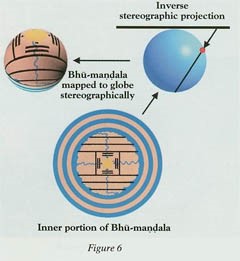
    This is the first model given by the Bhagavatam. A stereographic projection is an ancient method of mapping points on the surface of a sphere to points on a plane. We can use this method to map a modern Earth globe onto a plane, and the resulting flat projection is called a planisphere (Figure 5). 

    We can likewise view Bhu-mandala as a stereographic projection of a globe (Figure 6). In India such globes exist. 

    In the example shown here (Figure 7, next page), the land area between the equator and the mountain arc is Bharata-varsha, corresponding to greater India. India is well represented, but apart from a few references to neighboring places, this globe does not give a realistic map of the Earth. 

    Its purpose was astronomical, rather than geographical. 


    Although the Bhagavatam doesn’t explicitly describe the Earth as a globe, it does so indirectly. For example, it points out that night prevails diametrically opposite to a point where it is day. 

    Likewise, the sun sets at a point opposite where it rises. Therefore, the Bhagavatam does not present the naive view that the Earth is flat. 
     

    We can compare Bhu-mandala with an astronomical instrument called an astrolabe, popular in the middle Ages. 

    On the astrolabe, an off-centered circle represents the orbit of the sun—the ecliptic. The Earth is represented in stereographic projection on a flat plate, called the mater. 

    The ecliptic circle and important stars are represented on another plate, called the rete. Different planetary orbits could likewise be represented by different plates, and these would be seen projected onto the Earth plate when one looks down on the instrument.

    The Bhagavatam similarly presents the orbits of the sun, the moon, planets, and important stars on a series of planes parallel to Bhu-mandala.

    Seeing Bhu-mandala as a polar projection is one example of how it doesn’t represent a flat Earth.
     

    Bhu-mandala as a Map of the Solar System
     
    Here’s another way to look at Bhu-mandala that also shows that it’s not a flat-Earth model.

    Descriptions of Bhu-mandala have features that identify it as a model of the solar system. and   Bhu-mandala as a planisphere map.. When we do this, it looks at first like we’re back to the naive flat Earth, with the bowl of the sky above and the underworld below.

     In India, the earth of the Puranas has often been taken as literally flat. But the details given in the Bhagavatam show that its cosmology is much more sophisticated.

    Not only does the Bhagavatam use the ecliptic model, but it turns out that the disk of Bhu-mandala corresponds in some detail to the solar system (Figure 8). 

    The solar system is nearly flat. The sun, the moon, and the five traditionally known planets—Mercury through Saturn—all orbit nearly in the ecliptic plane. Thus Bhu- mandala does refer to something flat, but it’s not the Earth.
     

    One striking feature of the Bhagavatam’s descriptions has to do with size. If we compare Bhu-mandala with the Earth, the solar system out to Saturn, and the Milky Way galaxy, Bhu-mandala matches the solar system closely, while radically differing in size from Earth and the galaxy. 


    Furthermore, the structures of Bhu-mandala correspond with the planetary orbits of the solar system (Figure 9). If we compare the rings of Bhu-mandala with the orbits of Mercury, Venus (Figure 10), Mars, Jupiter, and Saturn, we find several close alignments that give weight to the hypothesis that Bhu-mandala was deliberately designed as a map of the solar system. 


    Until recent times, astronomers generally underestimated the distance from the earth to the sun. In particular, Claudius Ptolemy, the greatest astronomer of classical antiquity, seriously underestimated the Earth-sun distance and the size of the solar system. 

    It is remarkable, therefore, that the dimensions of Bhu-mandala in the Bhagavatam are consistent with modern data on the size of the sun’s orbit and the solar system as a whole.

    Jambudvipa as a Topographical Map of South-Central Asia

    Jambudvipa, the central hub of Bhumandala, can be understood as a local topographical map of part of south- central Asia. 

    This is the third of the four interpretations of Bhu-mandala. In the planisphere interpretation, Jambudvipa represents the northern hemisphere of the Earth globe. 

    But the detailed geographic features of Jambudvipa do not match the geography of the northern hemisphere. They do, however, match part of the Earth.
    Six horizontal and two vertical mountain chains divide Jambudvipa into nine regions, or varshas (Figure 11,top left). 

    The southernmost region is called Bharata-varsha. Careful study shows that this map corresponds to India plus adjoining areas of south-central Asia. The first step in making this identification is to observe that the Bhagavatam assigns many rivers in India to Bharata- varsha

    Thus Bharata-varsha represents India. The same can be said of many mountains in Bharata-varsha

    In particular, the Bhagavatam places the Himalayas to the north of Bharata-varsha in Jambudvipa.

     
    A detailed study of Puranic accounts allows the other mountain ranges of Jambudvipa to be identified with mountain ranges in the region north of India. 

    Although this region includes some of the most desolate and mountainous country in the world, it was nonetheless important in ancient times. For example, the famous Silk Road passes through this region. 

    The Pamir Mountains can be identified with Mount Meru and Ilavrita-varsha, the square region in the center of Jambudvipa. (Note that Mount Meru does not represent the polar axis in this interpretation.) 

    Other Puranas give more geographical details that support this interpretation.

    Bhu-mandala as a Map of the Celestial Realm of the Devas

    We can also understand Bhu-mandala as a map of the celestial realm of the demigods, or devas. One curious feature of Jambudvipa is that the Bhagavatam describes all of the varshas other than Bharata-varsha as heavenly realms, where the inhabitants live for ten thousand years without suffering. 

    This has led some scholars to suppose that Indians used to imagine foreign lands as celestial paradises. But the Bhagavatam does refer to barbaric peoples outside India, such as Huns, Greeks, Turks, and Mongolians, who were hardly thought to live in paradise. 

    One way around this is to suppose that Bharata-varsha includes the entire Earth globe, while the other eight varshas refer to  celestial realms outside the Earth. 

    This is a common understanding in India.

    But the simplest explanation for the heavenly features of Jambudvipa is that Bhu-mandala was also intended to represent the realm of the devas. Like the other interpretations we have considered, this one is based on a group of mutually consistent points in the cosmology of the Bhagavatam.

    First of all, consider the very large sizes of mountains and land areas in Jambudvipa. For example, India is said to be 72,000 miles (9,000 yojanas) from north to south, or nearly three times the circumference of the Earth. 

    Likewise, the Himalayas are said to be 80,000 miles high.

    People in India in ancient times used to go in pilgrimage on foot from one end of India to the other, so they knew how large India is. Why does the Bhagavatam give such unrealistic distances? 

    The answer is that Jambudvipa doubles as a model of the heavenly realm, in which everything is on a superhuman scale. 

    The Bhagavatam portrays the demigods and other divine beings that inhabit this realm to be correspondingly large.  Lord Siva in comparison with Europe, according to one text of the Bhagavatam.


    Why would the Bhagavatam describe Jambudvipa as both part of the earth and part of the celestial realm? 

    Because there’s a connection between the two. To understand, let’s consider the idea of parallel worlds. 

    By siddhis, or mystic perfections, one can take shortcuts across space. This is illustrated by a story from the Bhagavatam in which the mystic yogini Citralekha abducts Aniruddha from his bed in Dvaraka and transports him mystically to a distant city.


    Besides moving from one place to another in ordinary space, the mystic siddhis enable one to travel in the all- pervading ether or to enter another continuum. 

    The classical example of a parallel continuum is Krishna’s transcendental realm of Vrindavan, said to be unlimitedly expansive and to exist in parallel to the finite, earthly Vrindavan in India.

    The Sanskrit literature abounds with stories of parallel worlds. For example, the Mahabharata tells the story of how the Naga princess Ulupi abducted Arjuna while he was bathing in the Ganges River . Ulupi pulled Arjuna down not to the riverbed, as we would expect, but into the kingdom of the Nagas (celestial snakelike beings), which exists in another dimension.


    Mystical travel explains how the worlds of the devas are connected with our world. In particular, it explains how Jambudvipa, as a celestial realm of devas, is connected with Jambudvipa as the Earth or part of the Earth. 

    Thus the double model of Jambudvipa makes sense in terms of the Puranic understanding of the siddhis.

    Concluding Observations:
    The Vertical Dimension in Bhagavata Cosmology


    For centuries the cosmology of the Bhagavatam has seemed incomprehensible to most observers, encouraging many people either to summarily reject it or to accept it literally with unquestioning faith. 

    If we take it literally, the cosmology of the Bhagavatam not only differs from modern astronomy, but, more important, it also suffers from internal contradictions and violations of common sense. 

    These very contradictions, however, point the way to a different understanding of Bhagavata cosmology in which it emerges as a deep and scientifically sophisticated system of thought. 

    The contradictions show that they are caused by overlapping self-consistent interpretations that use the same textual elements to expound different ideas.

    In the Bhagavatam, the context-sensitive approach was rendered particularly appropriate by the conviction that reality, in the ultimate issue, is avak-manasam, or beyond the reach of the mundane mind or words. 

    This implies that a literal, one-to-one model of reality is unattainable, and so one may as well pack as much meaning as possible into a necessarily incomplete description of the universe. 

    The cosmology of the Bhagavata Purana is a sophisticated system of thought, with multiple layers of meaning, both physical and metaphysical. 

    It combines practical understanding of astronomy with spiritual conceptions to produce a meaningful picture of the universe and reality.

    Sunday, July 18, 2021

    The five sons of Draupadi and the Pandava brothers, killed by Ashwathama as they slept.

    The five sons of Draupadi and each of the Pandava brothers, killed by Ashwathama while they slept.

    In the Mahabharata, the Upapandavas are the five sons born to Draupadi from the each of the Pandava brothers. 

    They fought valiantly in the war between Pandavas and Kauravas from the side of their fathers.

    However, as pay back for what their fathers, the five Pandavas did, they were ambushed while sleeping at night and killed by Ashwathama.

    He did this out of rage after the death of his friend Duryodhana and father Dronacharya. 

    The five sleeping brothers were- 

    1 - Prativindhya, 

    2 - Satanika, 

    3 - Sutasoma, 

    4 - Srutasena, 

    5 - Srutakarma.

    1 - Prativindhya was the eldest (24 years old), he was the son of Draupadi and Yudhisthira. He was also the crown prince to the throne of Hastinapura. He is believed to be the incarnation of Chitraratha, who was a Gandharva. 

    As a baby, Prativindhya was left in Ekachakrapura and he later battled his uncle Arjuna during Yudhisthira’s Rajasuya Yajna. 

    It is said that his son Kalimshada succeeds Dhritarashtra as the king of Hastinapura, and marries a princess from Kuntibhoja’s family. Indraprastha is inherited by his sister’s son. 

    During the battle of Kurukshetra, Prativindhya was 24 years old, and fought alongside his father and uncles.

    2 - Satanika was the son of Draupadi and Nakula. He was the second of the Upapandavas. He was considered to be one of the avatars of Visvadevas, and was named after a famous king of the Kuru lineage. He along with his brother Prativindhya was appointed as one of the deputy commander-in-chiefs by Dhrishtadyumna. He killed an ally of the Kauravas, king Bhutakarma.

    3 - The son of Darupadi and Bheema, Sutasoma was the third Upapandava. He was a brave and talented warrior, who almost killed Shakuni during one of the battles. He was the favourite of Arjuna, and was given a bow and horses for his chariot by Arjuna. 

    4 - Srutasena was the son of Draupadi and Sahadeva and the fourth Upapandava. He had killed Shala, the younger brother of Bhurishravas, in one of the battles of Kurukshetra.

    5 - Srutakarma was the youngest of the Upapandavas and the most pampered. He was the son of Draupadi and the great warrior Arjuna. 

    He was very young at the time of the battle, but his young age and inexperience did not stop him from facing battled hardened warriors like Dushasana and Ashwathama in the war. It is said, that the horses of his chariot bore the colour of the kingfishers.

    A very disheartened and broken Ashwathama sat under a large tree after the death of his friend Duryodhana and the defeat of the Kauravas on the last day of the war. 

    He got the idea of attacking the Pandavas at night after seeing an owl attacking the crows which had attacked it in the day time. 

    He saw this as a sign and started formulating plans for the death and downfall of the Pandavas, who were the reason behind his pain and suffering.

    He gathered the last remaining warriors from the side of the Kauravas- Kritavarma and Kripacharya, and attacked the Pandava camp on the night of the last day of war, day 18. 

    He killed many skilled and prominent warriors like Shikhandi and Dhristadyumna while they were sleeping. 

    As Kritavarma and Kripacharya were positioned at the entrance of the camp, those who tried to flee the wrath of Ashwathama were hacked down by them.

    He saw five figures sleeping in the dark and thought them to be the Pandavas, so he ended up killing them. But it turned out he knew they were the 5 sleeping Upapandavas, Prativindhya, Satanika, Sutasoma, Srutasena, Srutakarma and purposely killed them to outrage their fathers.   

    Some versions of the Mahabharata say he purposefully killed the Upapandavas so that the Pandavas won’t be left with any heirs.

    This led to Parikshit, the grandson of Arjuna and son of Abhimanyu to succeed Yudhisthira to the throne of Hastinapur. 

    In another version of the Mahabharata, Parikshit was mentored and trained by Prativindhya, Shrutasoma, Sutasoma, and Satanika. In this version, it is said that Ashwathama killed the other children of the Pandavas, like Yudhisthira’s son through Shaivya, Bhima’s son by Jalandhara, Sarvaga, and Nirmitra, the son of Nakula by Karenumati.

    The story of the Upapandavas does not end here. The most interesting aspect of their story begins long, long before the Pandavas or Kauravas were born, many years ago.

    Markandeya was one of the greatest devotees of Lord Shiva. He was destined to die at the age of 16, but Lord Shiva was so pleased with his devotion that he stopped Yamaraj, the Lord of Death, from taking Markandeya with him. He also granted him the boon of immortality.

    Markandeya is the author of Markandeya Purana, which has stories from the Mahabharata. 

    The Purana is in the form of a dialogue between Jaimini, a student of sage Veda Vyasadeva, and four birds who were considered to be Dronacharya’s sons- Pingaksha, Sumukha, Vibodha and Suputra.

    The birds tell the story of the Upapandavas, who had to die at a very young age EVEN though they had Lord Krishna’s protection.

    There was a just and noble king in the Treta Yuga, called King Harishchandra. Once when he was on a hunt, he heard someone calling for help. He stopped the hunt immediately and rushed to the place from where the cries were coming.

    Over there, he saw sage Vishwamitra deep in meditation, and realized that someone was trying to stop his penance by unfair means. The sage broke his meditation angrily and Harishchandra told him the whole story.

    The sage was still angry at Harishchandra for disturbing him, so he asked him for alms. The king said he could have anything that he wanted. Vishwamitra asked for his kingdom and all his wealth. Having no attachment for worldly desires, the king readily agreed. Vishwamitra also asked him to leave the kingdom with his family.

    The king did so, but had to face many hardships. His family was sold as slaves. The king worked for a man who worked at a funeral ground, and tended to dead bodies. 

    His wife was sold to another family where she worked as a maid. Their son, Rohitashwa died after being bitten by a snake. 

    The story ended with the king performing a yagna, which resulted in the king and queen attaining salvation and their son being brought back to life.

    However, the sage was not happy with all this. Just when he was about the hit the king with his rod and destroy him, the people of the kingdom, who were filled with wrath, and the gods watching from heaven, who did not like Vishwamitra’s attitude, tried to stop him. 

    Angrily, the five Vishwa Devas appeared over there and accused the sage of being inhuman for treating the king that way, and disrespected him.

    The sage could not bear the insults and cursed the five Vishwa Devas. He picked up some water from his kamandalam and cursed the Devas to be born as humans. 

    He also told them that they won’t have children or get a chance to get married. They will only be able to return to the heavens as celestial beings after their death.

    Thus, these five Vishwa Devas were born as the five sons born to Draupadi from the each of the Pandava brothers.

    Prativindhya, 

    Sutasoma, 

    Srutakarma, 

    Satanika,

    Srutasena.

    They were eventually killed by Ashwathama because of the curse given by Vishwamitra, and they went back to the heavens as celestial beings and became the Vishwa Devas again, after their death.

    So where is Ashwatthama now?

    It is said that Ashwatthama is still alive today, but not as a result of being immortal but rather as being cursed by Krishna. 

    Ashwathama at the end of the war promised Duryodhana that he would kill the Pandavas and, as said above, attacked the Pandava camp in the middle of the night, murdering the 5 sons of the Pandavas, borne by Draupadi.

    The Pandavas, incensed by this act, chased him resulting in his fight with Arjuna. 

    During the fight, Ashwatthama invoked the 'Brahmastra' against Arjuna and Arjuna in response invoked the "Pashupatastra" which is an irresistible and most destructive personal weapon of Shiva, Kali and Adi Para Shakti, which can be discharged by the mind, the eyes, words, or a bow.

    Fearing the destruction of the world, the sages advised both to take back their weapons. 

    While Arjuna could do so, Ashwathama could not and was given the option of choosing any single target to destroy. 

    Out of spite, Ashwathama directed the weapon to the womb of Uttara, Arjuna's daughter-in-law. At this time, Uttara was carrying the unborn Parikshit, son of Abhimanyu, who upon birth would be the future heir to all the Pandava brothers. 

    The Brahmastra weapon was successful in fatally burning the foetus, but Krishna revived the stillborn child and cursed Ashwatthama with leprosy and to roam the world for 3,000 years as an unloved castaway.

    In another version, it is believed that he is cursed to remain alive till the end of the Kaliyuga. It is believed that Ashwatthama migrated to the land currently known as Arabian peninsula.

    Now, if the above story is true, then Ashwatthama should be still alive and there has been proof (even though vague) that he indeed is.

    A doctor in Madhya Pradesh claimed to have a tough patient with a septic forehead. 

    After several applications of a fail-proof potion, the wound was still fresh and kept bleeding. Amazed at this, the doctor said that his wound seems ageless and cureless. 

    He added, by saying, “I wonder, are you Ashwathama”, and laughed.

    When he turned to apply the next doze, he found the patient seat empty. The patient just disappeared into thin air - the story it was claimed was true.

    Some Yogis like Pilot Baba also claim that they have met Ashwatthama who was living among tribes at Himalayan Foothills. 

    It is believed that Ashwatthama offers flowers to a Shivling each morning. 

    Apart from this, according to locals a very tall man with noticeable dent in his forehead and in the middle of his forehead visits a restaurant owner once every year, somewhere on the foothills of the Himalayas.

    However, even with all these stories, Ashwatthama sightings are very rare since he has the power to choose to be visible or remain invisible.^^


    Saturday, July 17, 2021

    The eternal individual jiva-souls are known as the "marginal plane or potency," or marginal living entities.

    This means they can choose to voluntarily interact with Kṛṣṇa with loving exchanges based on "free will" in the spiritual world, or choose to ignore Kṛṣṇa and enter the material world. 

    The jiva-souls who choose to remain in the spiritual world, have one of five primary relationships with Krsna there.

    Being "marginal" means the individual jiva-souls are influenced by either the spiritual energy, or the material energy.

    Marginal therefore means the jiva-souls, who by nature are spiritual beings, are "in-between" the influence of the spiritual and material energy, with the added attribute of "free will."

    All marginal living entities (individual jiva-souls) have their own exclusive unique relationship with Krsna, each are equally intimate in an exclusive relationship with Krsna (God) in His Kingdom in the spiritual world in an unlimited variety of pastimes.

    In the spiritual world, all relationships with Krsna are "equally blissful to each other," just like one may like a carnation flower, while others may choose to like a rose flower.

    Srila Prabhupada - “The individual jiva-soul's position in the spiritual world is always voluntary. Some devotees want to serve Krsna as flower; they become flower there. If I want that "As a flower I shall lie down at the lotus feet of Krsna," he becomes flower, voluntarily, and he can change his, from flower to human body. That is spiritual life. There is no restriction. If some devotee wants to serve Krsna as cow, he serves Krsna as cow, as calf, as flower, as plant, as water, as ground, field, or as father, as mother, as friend, as beloved, anything. It is inconceivable, yet a fact." (SB, Canto 6 Ch 1 text 1-4 Melb, Australia May 20, 1975)

    The eternal individual jiva-souls are known as Krsna's “marginal energy,” the marginal energy (jiva-souls) means they are separated living entities who have no origin.

    This means the jiva-souls are beginningless and endless and were never created by Krsna, even though their original infinite home is Goloka-Vrindavana. 

    This clearly confirms the individual jiva-souls do not come from tatastha-sakti, the impersonal brahmajyoti or the Body of Maha-Visnu (all conditions outside the spiritual world the jiva-soul's fall too), simply because they have always existed.

    The marginal potency or realm throughout the spiritual Sky ARE the individual jiva-souls!

    The word "marginal" simply means the eternal individual jiva-souls can be under either the influence of the spiritual energy, or the material energy.  

    The marginal realm or potency is NOT a place in the Cosmos, no, it is a word describing a categories of living entities known as the individual jiva-souls.

    The marginal living entities or jiva-souls eternally exist throughout the entire Spiritual Sky and found everywhere.

    Only when the individual jiva-souls fall from the spiritual world which is their natural home, do they enter the temporary material world of repeated birth and death which takes up 25% of the spiritual sky.

    While in the temporary decaying material world, the individual fallen jiva-souls enter into 8 million 400 thousand temporary material bodily species of life and suffer repeated birth and death.

    The marginal potency or marginal living entities are the eternal individual jiva-souls in the spiritual world, and covered by a temporary material bodily vessel in the material world.

    Many misunderstand this fact due to nonsense impersonal teachings that deny the eternal individual spiritual nature of the jiva-souls.

    Some gurus, sannyasis, scholars and devotees foolishly claim the eternal individual jiva-souls originate from a "clear sheet of consciousness that is growing and expanding because of new jiva-souls being created." 

    This impersonal nonsense argument above must to destroyed while properly attempting to understand spiritual life.

    There is no origin to Krsna's marginal energy (an unlimited number of individual jiva-souls), who have existed just as long as Krsna has existed as Bhagavad Gita As It Is confirms. 

    Bhagavad Gita As It Is - “Never was there a time when I did not exist, nor you, nor all these kings; nor in the future shall any of us cease to be.” (BG, Ch 2 text 12)

    Bhagavad Gita As It Is - “As the embodied soul continuously passes, in this body, from boyhood to youth to old age, the soul similarly passes into another body at death. A sober person is not bewildered by such a change." (BG, Ch 2 text 13)

    Bhagavad Gita As It Is - "For the soul there is neither birth nor death at any time. He has not come into being, does not come into being, and will not come into being. He is unborn, eternal, ever-existing and primeval. He is not slain when the body is slain." (BG, Ch 2 text 20 “corrected” 1983 edition)

    Bhagavad Gita As It Is - "O Pārtha, how can a person who knows that the soul is indestructible, eternal, unborn and immutable kill anyone or cause anyone to kill?" (BG, Ch 2 text 21)

    Bhagavad Gita As It Is - "As a person puts on new garments, giving up old ones, the soul similarly accepts new material bodies, giving up the old and useless ones." (BG, Ch 2 text 22)

    Bhagavad Gita As It Is - "The soul can never be cut to pieces by any weapon, nor burned by fire, nor moistened by water, nor withered by the wind." (BG, Ch 2 text 23)

    All devotees (individual jīva-soul) are eternal unique persons as a spiritual bodily form, therefore there are no new jiva-souls being created because they have always existed meaning they are beginningless and endless.

    Srila Prabhupada - "There is no new jiva-souls ever created, new and old are due to this material body, but the jiva-soul is never born and never dies, so if there is no birth, so can how there can be new jiva-soul? Not possible." (Letter to Jagadisa dasa 9th July 1970) 

    The marginal platform means the eternal individual jiva-souls or spirit souls are naturally individual persons in the spiritual world serving Krsna

    The  are called "marginal living entities" because they can choose to be influenced by either the spiritual energy, or material energy eternally, explained by Srila Prabhupada-

    Srila Prabhupada – “The jiva-souls are Krsna’s marginal energy. Marginal energy means the jiva-souls may be under the control of the spiritual energy, or they may be under the control of material energy. But when the jiva-souls are under the control of the material energy, that is their precarious condition, struggle for existence. And when they are under spiritual energy, that is their original position and life of freedom.” (Los Angeles, Nov 23, 1968)

    Srila Prabhupada - "We (the eternal individual jiva-souls) are marginal energy (jiva-souls) Marginal means sometimes internal, sometimes external. When we are under the internal energy, that is our normal life, and when we are under the external energy, that is our abnormal life. Therefore, we are called marginal energy (jiva-souls); we can be either this way or that way. But being qualitatively one with the purusa, our tendency is to remain in the internal energy. Being in the external energy is our artificial attempt." (Letter to Lilavati, Allston, Mass 25 April, 1969)

    Srila Prabhupada - "The material energy, called as Maya, is also one of the multipotencies of the Lord, as much as we (the jiva-souls) are also marginal potency of the Lord. The living entities (jiva-souls) are described as superior energy than matter, when the superior energy is in contact with inferior energy, it becomes an incompatible situation. But when the supreme marginal potency (jiva-souls) are in contact with the spiritual potency, Hara, it becomes the happy, normal condition of the living entity." (The Happening Album, New York City, Dec 1966)

    Srila Prabhupada - "You are also energy; you are marginal energy (jiva-soul) Marginal energy means you (the jiva-souls) may be under the control of the spiritual energy or you may be under the control of material energy—your marginal position. But when you are under the control of the material energy, that is your precarious condition, struggle for existence. And when you are under spiritual energy, that is your life of freedom." (Intro BG As It Is, Los Angeles, Nov 23, 1968)

    Therefore, being “generated” from the marginal plane does not mean the jiva-souls “originated” from some so called place in the Brahmajyoti.

    First of all, being "marginal" means having free will, or having the choice to be influenced by the spiritual energy (the jiva-souls nature position and full potential) or influenced by the material energy (unnatural conditioned state). As said above, the real meaning of "marginal" means the jiva-souls can choose to be influenced by either the spiritual energy, or the material energy based on their free will.

    There is no origin to the individual jiva-souls, they are eternally parts and parcel of Krsna and just as old as Krsna.

    Srila Prabhupada – “The individual jiva-souls are Krsna's marginal energy. Marginal energy means we can live either in this external energy or in the internal energy, in between. So at the present moment we are living in the external energy. But this external energy is also Kṛṣṇa's energies, God's energy. It is not different from Him. But the external energy means we are captivated by the external energy. But the external energy is not permanent. The internal energy is permanent. The spiritual world is permanent, and the jiva-souls are also permanent as Bhagavad Gita As It Is Chapter 2 text 20 (1983 edition) reveals.” (Lecture BG, Ch 9 text 4 Melb, Australia April 23, 1976)

    Bhagavad Gita As It Is explains the individual jiva-souls have existed for infinity. This means, just like Krsna, the jiva-souls are beginning less and endless and were never created.

    Loving voluntary relationships with Krsna one number from one to five-

    1 - Neutrality, 

    2 - Servitude, 

    3 - Friendship, 

    4 - Parental affection, 

    5 - And conjugal love.

    A devotee has a relationship with Krsna the Supreme Personality of Godhead and cause of all causes, in five different ways-

    1. One may be a devotee in a passive (inactive) state;

    2. One may be a devotee in an active state;

    3. One may be a devotee as a friend;

    4. One may be a devotee as a parent;

    5. One may be a devotee as a conjugal lover.''

    Srila Prabhupada explains these five relationships in detail in the Book "Nectar of Devotion."

    A "PASSIVE" relationship (number one in above list) with Krsna in the Vaikuntha planets and Goloka Vrindavana, is an almost "inactive" position the jiva-souls can CHOOSE according to their desires ("free will") such as-

    A cloud in the sky,

    The Sky 

    A blade of grass, 

    A tree,

    A rock or stone,

    A fence,

    A chair or bench,

    A flag pole or a flag

    A roadway, 

    A Chariot, etc

    The point is, everything is alive with individual life in the Vaikuntha planets and Goloka-Vrindavana, unlike the mundane dead material energy in the material world.

    This means everything from the shoes on your feet, to the clothes you wear, are all individual jiva-souls who have shape shifted as that form because they have chosen to play that particular role on the Vaikuntha planets and Goloka Vrindavana. This is called a "passive" relationship with Krsna.

    Many jiva-souls choose to have that passive (inert, inactive or idle) relationship with Krsna but it is NEVER impersonal. 

    This means they do not react visibly to something that might be expected of them, like outwardly manifesting emotions or feelings.

    Like a blade of grass or a tree is only seen moving in the wind and outwardly showing no emotion or passion.

    Even though "inwardly" the jiva-soul, as that blade of grass or tree, is ecstatically blissfully completely aware of Krsna’s personal presence, and Krsna is fully aware of those personalities as the the blade of grass, or as a tree, there for Krsna's pleasure.

    Many jiva-souls are therefore passive living beings in Vaikuntha or Goloka Vrindavana that do not being involved in visible reactions or active participation.

    They simply choose to exist for the pleasure of Krsna.

    Everything is alive as individual personalities in Vaikuntha and Goloka-Vrindavana however, many jiva-souls are playing a passive inactive role in Krsna's Kingdom.

    It is important NOT confuse a "passive relationships" in Vaikuntha or Goloka-Vrindavana with impersonal mundane "inactive nonsense oneness" of the Mayavadis.

    The fact is, Krsna's abode is full of diversity where the jiva-souls can voluntarily express themselves in unlimited ways, engaging in an endless variety of pure devotional service for Krsna.

    For example, from active service of being a Cow herd boy or cow, to inactive service like being a flag on top of a flag pole or being the flag pole. 

    1 - Devotees in the mood of "neutrality" choose to witness and support Krsna’s pastimes by their presence as plants, animals, streams, and so on, as well as normally inanimate objects like houses—all of which are fully conscious and alive in Goloka Vrindavan.

    2 - Devotees in the "service mood" choose to run errands for Krsna, pack His lunch, wash His clothes, and perform other acts of loving service for Him.

    3 - Devotees in the "fraternal mood" choose to serve Krsna by being His friends. They are sometimes boastful, considering themselves equal to Krsna because they have no idea Krsna is the Supreme Personality of Godhead and cause of ALL causes, nor do they care. 

    In Krsna's company the cow herd boys and girls enjoy games in the beautiful country forest settings of Vṛndāvana.

    4 - Devotees who choose to be in the "parental mood", see themselves as Krsna’s provider and protector. Krsna behaves with them like a dependent child. His mother cuddles Him, carefully prepares His meals, and thinks only of His protection. His father sees that He has all the comforts of a normal home.

    5 - Devotees who choose to be in the "conjugal" (of whom many are also Visnu-tattva and NOT just jiva-souls) position, or romantic, mood offer service as Krsna’s girlfriends, relating with Him in the intimacy of lover and beloved.

    These relationships with Krsna are also based on reciprocation and loving exchanges too, even if the jiva souls manifest themselves as a cloud in the sky, a bench for Krsna to sit on, or a plate for Krsna to eat off.

    Just like we enjoy relationships with our families and society, so does Krsna.

    However, all of His relationships are eternal in Goloka-Vrindavana with their "svarūpa spiritual form, and completely free of material contamination.

    Each of Krsna’s jiva-soul devotees interacts with Him by their "free will" in one of the above five primary relationships with Krsna  but can also change their rasa if they choose and be what ever they want to be serving Krsna. 

    All jiva-souls are equally intimate with Krsna because in the Spiritual World all relationships with Krsna are equally blissful, just like one may like a carnation flower while others like rose flower.

    Only small minority of jiva-souls are not granted their full potential of free will because they choose to leave the Spiritual Worlds and enter the mundane restricted material creation.

    In the material creation the jīva-souls are conditioned by the kind of material bodily vessel they have possessed.

    There are 8 million 400 thousand species of material life that the fallen jiva-souls can enter.

    Free will therefore is restricted to those jiva-souls who have chosen to enter the mundane material creation.

    In the material creation all species of life are forced to act under the modes of material nature which are eating, sleeping, mating and defending.

    Therefore almost all jiva-souls (except for a rare few in the human form) have no "free will" in the bodily conditioned state. They only act under the instincts of eating, sleeping, mating and defending.

    As said above, even in the rare human form of material life there is a very little free will.

    The human form is also controlled by the karmic reactions to one's pious and impious actions, therefore piety can help one start their search for spiritual knowledge if they get a good birth, but is not always the case.

    Free will in its "full potential" IS only experienced in Vaikuntha and Goloka Vrindavana (The Kingdoms of God) so that meaningful voluntary loving exchanges with Krsna always exists.

    If the jiva-souls had no "free will" in the Spiritual World, then they are no better than dead stone Prabhupada tells us.

    Srila Prabhupada - "If you have no "free will", then you are a stone. The stone has no "free will". You want to be stone? Then you must have "free will!" But don't misuse your "free will". But don't try to become stone either. That is not life." (Aug 5, 1976, New Mayapur France)

    Srila Prabhupada – “So everyone can know that independence means one can use it properly, or one can misuse it. That is independence. If you make it one way only, that is not independence, that is force.” (Los Angeles, June 23, 1975)

    Srila Prabhupada - "Free will means that you can act wrongly. That is free will. Unless there is chance of doing wrong or right, there is no question of free will. Where is free will then? If I act only one sided, that means I have no free will. Because we act sometimes wrongly, that means free will."

    Hayagriva dasa⁰ - "A man may know better but still act wrongly."

    Srila Prabhupada -"Yes, but that is "free will". He misuses his. Just like a thief, he knows that his stealing, it is bad, but still he does it. That is free will. He cannot check his greediness, so in spite of his knowing that he is doing wrong thing—he will be punished, he knows; he has seen another thief, he was punished, he was put into prison— everything he knows, but still he steals. Why? Misuse of free will. Unless there is misuse of free will, there is no question of free will." (Excerpt from: Discussions Srila Prabhupada about Rene Descartes philosophy)

    Bali Mardana - "An example of free will is someone can choose Kṛṣṇa or turn away? Is that an example of free will?"

    Srila Prabhupāda - "Yes, because if you accept Kṛṣṇa, then you must follow what Kṛṣṇa says. If you don't follow Kṛṣṇa, then what is the use of talking of Kṛṣṇa? If he accepts Kṛṣṇa, he must abide by the injunction of Kṛṣṇa."(Morning Walk, Jan 22, 1974, Hawaii)

    Srila Prabhupada - "So, unless there is a possibility of misusing our free will, there is no question of freedom." (Dialectical Spiritualism, Critique of Descartes)

    Srila Prabhupada - "If you have no free will, then you are a stone. The stone has no free will. You want to be stone? Then you must have free will! But don't misuse your free will. But don't try to become stone either. That is not life." (Aug 5, 1976, New Mayapur France)

    The individual jiva-souls are independent separate living entities in the spiritual world who have their own unique personality and sense of self that is separate from Krsna's Personality, yet simultaneously dependent on Krsna as His eternal parts and parcels.

    The reason why Krsna gives the jiva-souls their independence and "free will" is so they can voluntarily choose for themselves how to serve Him and contribute to the relationship in their own unique personal way.

    This means the jiva-souls can always contribute their own unique offerings without any pressure or force from Krsna.

    Real love or service can only exist when "free will" allows the jiva-souls to voluntarily participate in loving devotional exchanges and contribute to the relationship with Krsna and therefore expanding it.

    Surrender to Krsna in the spiritual world does not mean giving up your free will and allowing Krsna to control your every actions, deeds, words and thoughts.

    No, the jiva-souls in the spiritual world are NOT programmed mindless drones who only obey and never contribute to the relationship with Krsna in their own unique way by thinking for themselves the different ways to serve Krsna.

    Only by having free will can genuine loving exchanges and reciprocation take place, and without free will the jiva-soul is no better than dead stone Prabhupada has warned us.

    Krsna NEVER interferes with the "free will" of the jiva-souls because if He did and never allowed them to have their "freedom of expression" to make their own choices in the spiritual world, then that also would mean loving exchanges and voluntarily participation and reciprocating with Krsna would never exist.

    If the jiva-souls are forced to worship Krsna or Visnu then that is NOT loving voluntary exchanges that personalism is bases on, it is lovess cold impersonalism.

    This "impersonal" version of Krsna's abode in Goloka-Vrindavana or on the Vaikuntha planets mentioned above, where the jiva-souls are forced to surrender (abandon) their "free will" to Krsna, and then let Him take over their individual existence by doing all their thinking for them, as many nonsense sangas (religious cults) propagate, is dangerous IMPERSONALISM.

    Srila Prabhupada - "Their impersonalist philosophy is "oneness." So how there be love with just one? Is it possible? Have you got any such experience that love means one? No. Love means two. There MUST be two, the lover and the beloved. Kṛṣṇa is already lover. He loves you so much that He's trying to get you back. That is Kṛṣṇa's attempt. "Please, My dear boy, or My dear friend, My dear servant..." (Lecture on SB Canto 2 Ch 1 text 3, Paris, June 12, 1974)

    Srila Prabhupada - "We have got the propensity to love. Love means somebody else. Love cannot be one or love cannot be executed only one, personally. There must be another one. I love somebody; somebody loves me, there must be lover, there must be beloved, and the transaction, then love." (Lecture on SB, Canto 1 Ch 2 text 6, Delhi, Nov 12, 1973)

    Srila Prabhupada - "Love means you take and you give also. Suppose if you love somebody and you simply take from him, but you don't give. Oh, do you think it is very good? No. It is not good. That is NOT love. That is exploitation. If I go on simply taking from you, and if I don't offer you anything, that is simply exploitation." (Lecture on BG, Ch 9 text 2-5, New York City, Nov 23, 1966)

    Srila Prabhupāda – "Unless there are two persons, where is the question of love? Love means two persons, then there is exchange, then there is love. I must deal with you open-hearted, you must deal with me open-hearted, then there is love. So if you want to love Kṛṣṇa, God, then these things must be there." (Aug 9, 1976, Tehran)

    Having "free will" allows the jiva-souls to be the individual independent PERSON they are eternally in God's perpetual Kingdom, where they always choose to voluntarily contribute their own personal unique offerings to Krsna.

    This is the real Goloka-Vrindavana and Vaikuntha planets which is the permanent eternal home of the marginal living entities (jiva-souls).

    Srila Prabhupada - "So if by free will you choose to surrender to Krsna then you’ll get your real free will, real freedom, otherwise you are under the clutches of maya." (Morning Walk – 14 July 14, 1975, Philadelphia)

    The jiva-souls in Vaikuntha and Goloka Vrindavana are forever voluntarily expanding the expression of their unique individuality with an increasing variety of personal devotional offerings based on free will, it is NEVER a nonsense one-sided master/slave mindless impersonal relationship with Krsna as Prabhupada explains.

    Srila Prabhupada – "Love is reciprocal, voluntary, good exchange of feeling. Then there is love. Not by force, no, Krsna does not want to become a lover like that, ‘You love me, otherwise I shall kill you!" (Washington DC July 8, 1976)

    Many, in fact most, do not understand what the spiritual world's of the Vaikuntha planets and Goloka-Vrindavana really are, and the many points supporting PERSONALISM explained here.

    The "free will" to feel envy means you want to enjoy like Krsna and be in the centre instead of Krsna, such self centred desires immediately disqualifies you to remain in the spiritual world (Vaikuntha or Goloka-Vrindavana) and immediately you a transferred to the material creation managed by Maha-Visnu. 

    Your spiritual memories are in the spiritual world and you cannot take them with you to the material world because they are NOT material.

    Once the jiva-souls enter the material world, their free will is almost non-existent, and instead are directed by the demands of the material senses - eating, sleeping, mating and defending, found controlling all species of material life.

    Therefore, there is no choice in the spiritual world influenced by "matter" or "maya" because matter (maya) does NOT exist in the spiritual world.

    Also, maya is NOT the cause of the jiva-souls fall down from the spiritual world to the material world, "free will" is the cause of fall down, and that means there is always a choice that some nonsense sangas and their gurus cannot understand.

    The jiva-souls can only enter the material world in a material bodily vessel provided by Maha-Visnu, and NOT as their spiritual eternal bodily form.

    All knowledge of Vaikuntha and Goloka-Vrindavana is in the spiritual body, but now covered because one has entered the material world and is now covered by a temporary decaying material bodily vessel.

    In the spiritual world, as their original spiritual bodily form, all jiva-souls are female in their intimate original relationship with Krsna. 

    Yes, we are all female.

    Not to confused with mundane transgender in the material world because if one is given a material bodily vessel of either a male or female, then that life is who they are in that life. In their next life, one can be either male, female, dog, Cow, tree - all material life forms have a jiva-soul.

    However, in the spiritual world, even though one is originally female, they can appear as male, a cow, a tree, a bird, a street sign, a blade of grass, anything they like to serve Krsna.

    Srila Prabhupāda - "There is form, just like this material body is compared with the dress. Now, just like in your present material form you have got hand; therefore your coat has got hand. You have got legs; therefore your pant has got legs. Therefore it is to be assumed that the spirit soul always has got form, and is expressed as hands, legs, heads, everything. The spirit soul is not formless; it has got form. But with our material eyes at the present, gross eyes, we cannot find it; therefore we say and foolishly believe it has no form." (Lecture BG 2.14, Mexico, Feb 14, 1975)

    Devotee – "Is the original body of the spirit soul a human form?" 

    Srila Prabhupada – "Yes, human form, God is also human form. "Man is made after the shape of God." I think there is in the Bible. Is it not? So God is also like human form. Here you see Krsna, two hands, two legs."

    Hari-sauri dasa – "How do we understand, then, that there are peacocks and flowers and trees in the spiritual world? Are these not eternal forms?"

    Srila Prabhupada – "[describing material form first]: Yes, they are more covered. Just like if you cover your body with blanket, the hands and legs are invisible. But you are not the blanket. So the trees and plants, they are more covered. They are not in full manifestation. The human form is the full manifestation of the soul."

    Hari-sauri dasa - "They are covered in the spiritual world?"

    Srila Prabhupada - "Not in the spiritual world. There that is voluntary. Some devotee wants to serve Krsna as flower; they become flower there. If I want to be a flower I shall lie down at the lotus feet of Krsna, he becomes flower, voluntarily, and he can change his, from flower to human body. That is spiritual life. There is no restriction. If some devotee wants to serve Krsna as cow, he serves Krsna as cow, as calf, as flower, as plant, as water, as ground, field, or as father, as mother, as friend, as beloved, anything. It is inconceivable, yet a fact." (SB, Canto 6 Ch 1 text 1-4 Melb, Australia May 20, 1975)

    Srila Prabhupada - "The spirit soul is NOT formless; it has got form, the spirit soul always has form and is expressed as hands, legs, heads, everything. But with our material eyes at the present, our gross eyes, we cannot see these facts; therefore we foolishly believe the jiva-souls have no form." (Lecture BG, Ch 2 text 14 Mexico, Feb 14, 1975)

    Devotee - "What is the form of the spiritual body. If the spirit soul is non-material, what is the form?"

    Srila Prabhupāda - "There is form, just like this material body is compared with the dress. Now, just like in your present material form you have got hand; therefore your coat has got hand. You have got legs; therefore your pant has got legs. Therefore it is to be assumed that the spirit soul always has got form, and is expressed as hands, legs, heads, everything. The spirit soul is not formless; it has got form. But with our material eyes at the present, gross eyes, we cannot find it; therefore we say and foolishly believe it has no form." (Lecture BG, Ch 2 text 14, Mexico, Feb 14, 1975)

    Srila Prabhupada - "Your question about one's relationship with Lord Krsna on Krsnaloka, does he ever fall down? The jiva-souls are endowed with minute independence as part of their nature and this minute independence may be utilized rightly or wrongly at anytime, so there is always a chance of falling down by misuse of one’s independence." (Letter to Jagadisa dasa 25th April 1970)

    Srila Prabhupada - "In the broader sense, everyone comes from Krsnaloka (Goloka-Vrindavana). When one forgets Krsna, he is conditioned (nitya-baddha), when one remembers Krsna he is liberated (nitya-siddha)." (Letter to Mukunda, June 10, 1969).**.